5 Need-To-Know Workplace Occupancy Trends for 2026
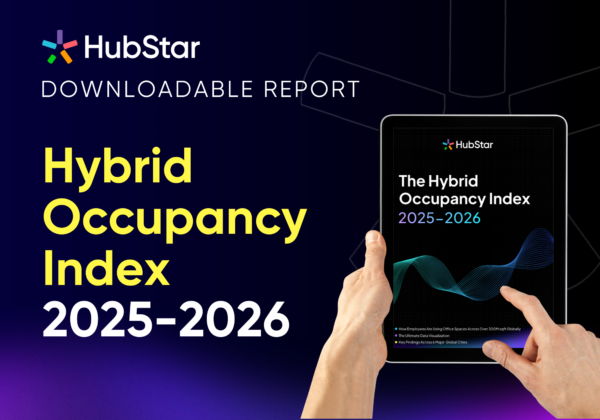
HubStar’s Hybrid Occupancy Index 2025 – 2026 is built on real workplace usage data from more than 300 million square feet of office space globally. Here are the index's top 5 takeaways and what workplace leaders can do with them.

Jackie Towers

Debating whether or not people are coming into the office is old news.
What’s actually interesting – and useful – is how employees are using office spaces when they do show up.
What types of spaces do employees prefer, which ones are sitting empty, and are the assumptions most workplace leaders have actually watertight?
To find out, we analyzed anonymous HubStar customer data from January 2023 through December 2025, collected via WiFi signals and occupancy sensors across 173 buildings, 13 countries, and more than 27,000 workspaces.
Download the Hybrid Occupancy Index 2025-2026
300 million square feet. 13 countries. 27,000 workspaces. Download the full report right here for all the data on how employees are using office spaces and the changes workplace leaders should be making.
Our objective was to understand real workplace patterns and preferences through space utilization data, not what policies say should be happening.
Here are the top five takeaways from the data and how you, the workplace innovator, can use it.
1) Tuesdays are the busiest days, which isn’t necessarily a bad thing, unless…
The data: Tuesday occupancy peaks at 59% globally, the highest of any weekday.
Why it matters: Having a day-of-the-week preference isn’t actually a bad thing. People naturally coordinate around mid-week collaboration, and that’s when the office delivers the most value. Where things get problematic is if occupancy is significantly lower on all the other days of the week, signalling that there may not be enough space for teams to sit together and a lack of vibrant vibes on the other days.
What to do: Instead of blanket three day in-office mandates that create artificial Tuesday traffic jams, use dynamic policies and team-level agreements to spread attendance more intentionally. Let teams self-organize their in-office days or use scheduling tools to balance occupancy across the week. Comparing utilization levels over the days of the week informs you if you have an actual space shortage problem or just an occupancy distribution problem.
2) People want small meeting rooms but they’re only finding boardrooms.
The data: 80% of meetings happen in rooms designed for six people or fewer. Meanwhile, the larger boardrooms built for 17+ people have utilization levels of just 12%.
Why it matters: Duking it out over the limited number of ideally sized meeting rooms is a tale as old as time. But the over-availability of boardrooms and lack of small rooms introduces a new and costly problem – one or two people hoarding space for hours on end because it was all they could find. That means a higher spend on utilities for mostly empty spaces and continuing frustration at not having the right space configurations for the work you want and need to get done when you put in the time commuting into the office.
What to do: Compare room usage data based on size. Convert oversized and underused boardrooms into multiple small meeting spaces permanently or even using modular dividers if you’re not ready for that scale of change.
3) Zoom rooms are where it’s at.
The data: Two-person meeting rooms operate at just 44% capacity when booked, likely because individuals are using them for video calls and focused work, not collaboration.
Why it matters: People are occupying spaces not built for purpose because they don’t have anywhere else to take calls without disrupting the open office. This creates a cascade problem: solo workers book collaboration spaces, teams can’t find rooms, collaboration suffers and boardrooms aren’t used for the right purpose either.
What to do: Build dedicated Zoom rooms and office pods. Give people proper spaces for calls and deep work so your collaboration areas can actually be used for collaboration.
4) Informal collaboration spaces have the biggest usage gains.
The data: Collaboration areas, social spaces, and event zones saw the largest utilization increases compared to 2024.
Why it matters: People come into the office to connect, brainstorm and collaborate. Workplace leaders and innovators have long suspected that individual workstations and conference rooms don’t support this, but we now have the data to verify this.
What to do: Lounge seating, standing collaboration zones, flexible event spaces and coffee corners. These are the new workplace magnets. Adding in more of them where the data shows it actually makes sense to do so can boost attendance and workplace efficacy.
5. The Return of the Cubicle.
The data: While 78% of available desks globally are open plan, cubicle-style and semi-private workspace usage is showing gradual but steady growth.
Why it matters: Remember when open plan offices were supposed to revolutionize collaboration? (Some critics have compared the design philosophy to prison layouts—maximum visibility, minimal privacy.) After years of all-in bets on open offices, the data shows the pendulum swinging back. People still want collaboration, but they also want spaces where they can think without constant interruption.
What to do: You don’t need to go full 1990s cubicle farm, but consider hybrid desk configurations that balance openness with privacy. Semi-private workstations, acoustic panels, and dedicated focus zones give employees the best of both worlds. Test small pilots, measure what works, and scale from there.
Download the report for the full story
Download the full 2025-2026 Hybrid Occupancy Index for detailed benchmarks, regional breakdowns and insights you can use to build a better workplace in 2026.
Jackie Towers
Share this post