4 Reasons Why Your Organization Needs Multiple Hybrid Work Policies
One hybrid policy to rule them all? We know how that story ends. Here are 4 reasons why your organization needs multiple hybrid work policies instead of one.

Jackie Towers

One hybrid policy to rule them all is a doomed approach from the start. Consequences range from disengagement to employees banding together in a fellowship to find new jobs.
Or, in the case of Ubisoft more recently, a full-blown employee strike.
The mismatch between one policy and a workforce full of different roles, teams, and working styles is exactly why so many hybrid policies fail to stick.
And why we’re seeing so many catastrophic failures make the headlines.
One hybrid policy that stipulates either the minimum days per week or specific days per week seems like it’s the status quo in 2026. On the plus side, since it’s the same for everyone, it’s fair, right?
Wrong. Strict, broad-brush hybrid policies aren’t fair to everyone, and while they might seem less time-consuming to roll out, the risk of backfire is more certain than not.
More than one hybrid policy, also known as a hybrid policy stack, may take more time to research and create. But it’s worth it in the short, medium and long term.
Hybrid Policy vs Reality Playbook
What does a successful hybrid policy stack actually look like? Download this playbook for a framework plus how to create policies grounded in reality, not assumptions.

1) Hybrid work fulfills different objectives for leadership teams.
Your organization’s Real Estate lead, HR director, CFO and IT director all have different definitions of what a successful hybrid policy looks like, because their jobs depend on different outcomes.
Real Estate wants to right-size the portfolio. HR wants to protect retention and culture. Finance wants to reduce overhead. IT wants security and infrastructure stability. None of them are wrong. But if you write one policy that tries to satisfy all of them equally, you’ll end up with something too vague to enforce and too rigid to follow.
Getting clear on what the organization actually wants hybrid work to achieve in specific priorities for the next one to two years has to come before any rules get written. Without that alignment, every policy debate becomes a proxy war for priorities that were never resolved in the first place.
2) Not everything should apply to everyone.
Some things genuinely do belong in a company-wide policy. For example, proximity requirements for roles that need to be near a specific site, shared moments like a quarterly all-hands, or an annual kickoff could be moments your company identifies where being in the room isn’t optional.
However, this isn’t a long list, and there’s a lot it doesn’t cover, including:
- What a worthwhile day in the office looks like for each team
- Which days are the best for teams to come in
- Whether attendance levels should vary depending on what’s on the agenda
The answers to these questions are different and can’t be covered by a company-wide policy.
Failed Hybrid Policy Guide: from Crisis to Competitive Advantage
Have you unintentionally rolled out the wrong hybrid work policy and Sauron'd your employees? Don't panic because the crisis is reversible. We'll show you how to do it in this guide.

3) Teams need their own policies, and managers need the autonomy to set them
Individual teams have the capacity to figure out, between themselves, when it makes sense to come into the office and when it doesn’t.
This is what happens when managers have the authority to define how their team works best. Research backs this up: 66% of employees report better mental wellbeing under hybrid work — but wellbeing is closely tied to autonomy. When that autonomy gets squeezed out by a top-down rule that doesn’t reflect how the team actually operates, resentment starts a-brewin’. People start treating the policy as something to comply with minimally and evade whenever they can.
Team-level agreements are where hybrid policy does its real work. Which means the number of hybrid policies you actually need is closer to the number of teams you have than the number of companies you are.
4) Individual exceptions are a policy too.
Caring for family members, a health condition and/or a life circumstance that requires a different arrangement are all reasons people need more flexibility, and they deserve a real response.
The mistake is handling them informally. A verbal agreement with a manager who then leaves the company is a liability. The employee is left with nothing documented, and the organization has no consistency across how exceptions are handled.
Individual exceptions need to be written down, time-bound, and reviewed regularly because documentation is what makes it fair. When people know there’s a clear process for asking and a clear expectation of what happens when they do, flexibility stops being something you have to negotiate for and starts being something that’s available to everyone.
One hybrid policy for everyone sounds efficient. In practice, it’s a shortcut that costs you more than it saves in compliance headaches, manager and employee disengagement and increased turnover.
If you’re looking for some help creating your hybrid policy stack, we’ve got you covered.
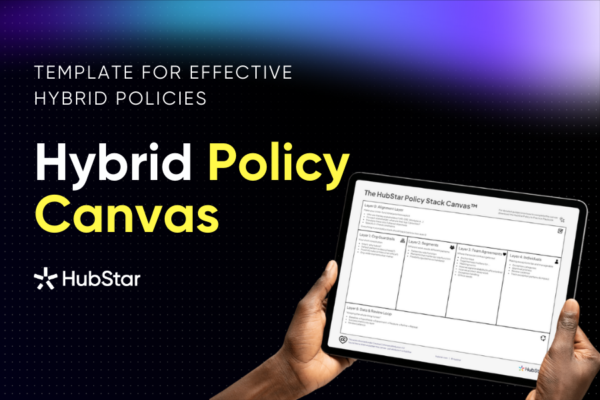
Hybrid Policy Stack Template
Download this template for the framework you need to create hybrid policies that work for every level of your organization, from the C-Suite down to the individual.
Jackie Towers
Share this post