5 Reasons Why Hybrid Work Policies Fail
Hybrid work policies fail when they're disconnected from business goals, built without visibility into real attendance habits, don't give managers any decision-making power, left with undocumented exceptions, or never measured with data to iterate. These five gaps explain most of the public return-to-office backlash of the past two years.

Jackie Towers

We’ve seen some pretty public hybrid work policy and RTO mandate failures over the last couple of years.
From 91% employee dissatisfaction ratings after Amazon’s 2024 full-time RTO mandate to Paramount forking out $185 million in post-mandate severance packages more recently, it’s become clear that rolling out any policies asking employees to spend more time in the office is risky business.
But are all hybrid policies innately wrong, despite what the headlines and evidence shows? Is the answer just an attendance free-for-all?
Not necessarily. In this post, we’ll cover five reasons hybrid policies fail.
Design a policy that doesn't fail with the Hybrid Policy Playbook
Download for a (realistic) hybrid policy framework, a 4 step implementation plan and tips for getting business objectives, office spaces and the ways employees actually want to work all moving together in perfect harmony.

Reason 1) Your organizational hybrid policy is disconnected from reality and business objectives.
The first step to creating effective hybrid policies is to articulate the why:
- Why a policy is required
- Why working in the office is beneficial
- Why in-office working supports the organization’s goals
Companies rolling out strict RTO mandates, including Instagram and Paramount more recently, state that employees are more “creative and collaborative” in person. But the supporting evidence behind this is never shared, leading employees to believe, perhaps rightly so, that leadership values appearances and getting ROI from expensive leases over actual productivity and employee wellbeing.
It’s a violation of the often unspoken contract that the employers trust the best judgement of employees to get their work done in the most efficient ways.
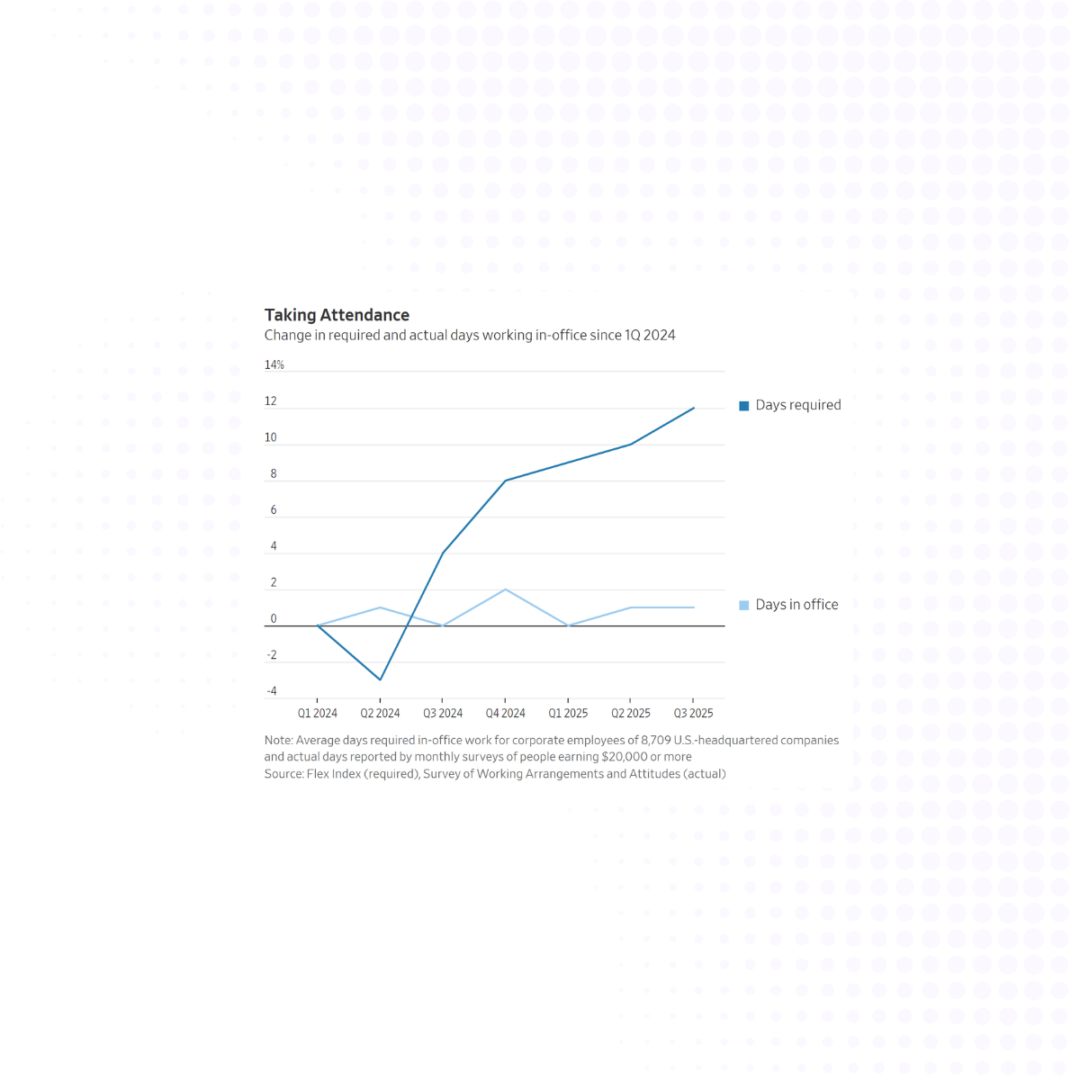
It’s no wonder, then, that RTO mandates are now proven to have minimal impact on office attendance.
Reason 2) There’s no visibility into teams’ workplace habits and preferences.
A hybrid policy that works is one that integrates nuance. That starts with understanding that each team will have different needs and wants when it comes to working in the office and especially the environments and amenities they have access to when they’re in.
The development team doesn’t need to be in the office as frequently as the HR team, for example. Marketing might need to be in three times a week, while it would be a waste to assign every salesperson a desk five days a week because they’re off meeting clients for most of those days.
When leadership makes no effort to understand these differences and unfurls a constrictive blanket over everyone in the name of “better collaboration and creativity”, it shows people that the priority is rule compliance, not job performance.
That’s a recipe for simmering resentment that leads to hybrid policy failure and a resignation fiesta of senior and most skilled employees.
Failed Hybrid Policy Guide: From Crisis to Competitive Advantage
Check out this guide for more nuance on the reasons hybrid policies fail, real-world examples, and what to do to turn a crisis into a competitive advantage.

Reason 3) Managers don’t have the autonomy to create team-level hybrid agreements.
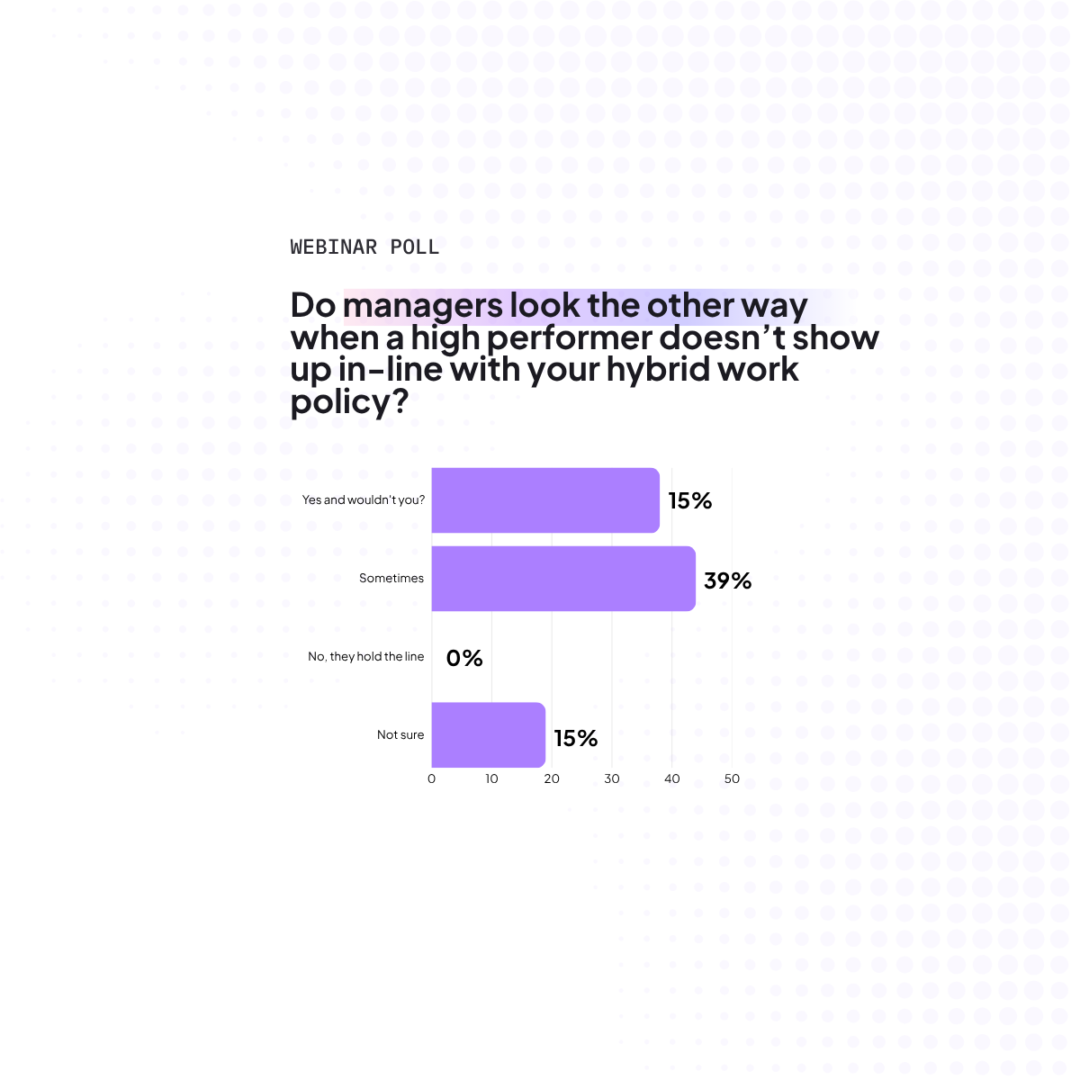
Only 39% of middle managers agree with their company’s RTO mandate, and 40% ignore non-compliance when it happens on their team.
This shouldn’t come as a surprise. As a manager responsible for your team’s performance, output and satisfaction, what are you going to do if your number one salesperson comes in once per week instead of three times? Raise the issue with HR so they get written up and resign the week after? Absolutely not.
In our recent Hybrid Policy vs Reality webinar, we polled our audience of workplace leaders and their responses echoed these sentiments exactly:
Managers understand the dynamics of their teams, and they’re in the best position to start the discussions that create an agreement everyone’s had a say in. Policies like this are the ones that ultimately stick, because they have stakeholder buy-in.
Failing to acknowledge this at a leadership level doesn’t just create resentment at the employee level. It leaves managers feeling frustrated, morally conflicted and unengaged from enforcing a policy they don’t agree with
Manager engagement fell from 30% to 27% in Gallup’s State of the Workplace report last year, one of the most significant contributors to the $438 billion disengagement costs globally.
Reason 4) Individual policy exceptions aren’t “allowed” but the ones that do exist aren’t documented.
Jumping back to reason number three – if a top performer can only come into the office once a week at most because of childcare or living 100 miles away from the office, what sane manager is going to force them back in?
Stamping out individual exceptions to hybrid work policies isn’t just a turnover risk, but a wellbeing one too. Over a third of employees reported that fear of being forced back into the office negatively impacts their mental health.
Whether flexibility is needed for family reasons, health reasons, or just the hard truth that commuting into the office would blow their budget, it’s in an individual’s best interest to quietly ignore a hybrid policy.
But this creates even more problems when a colleague who sucked it up and now spends three hours a day commuting to comply with the mandate finds out their colleague has a completely different arrangement. Management knows about it too. Why are some people more deserving of exceptions than others? Cue an organizational mudslide of mistrust, cynicism and resentment.
Hybrid policies fail when no one’s taken time to articulate and document who meets the bandwidth for a policy exception and why.
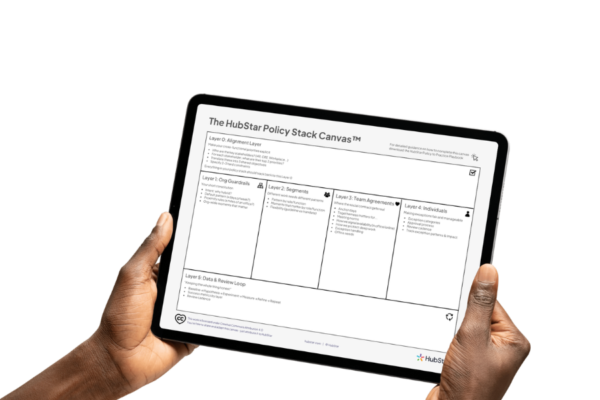
Hybrid Policy Creation Template
Map out effective policies with this template that helps you answer the right questions from the organizational down to the individual level.
Reason 5) There’s no data to measure, iterate and improve hybrid policies.
You can’t improve what you can’t measure. But in the case of hybrid policies, you can’t maintain what you can’t measure either.
Amazon’s 2025 post-RTO mandate desk shortage fiasco is a prime example. The data organizations need to create an effective hybrid policy also includes the available supply of workspaces – square footage, meeting rooms and desks.
Other important pieces of the data puzzle include attendance data at the organizational, site, team and neighborhood level and qualitative sources like employee engagement surveys.
And although we’ve included data as the final reason for failure here, it can also be the first reason why a hybrid policy fails and the reason why performance can’t be measured and improvements can’t be made.
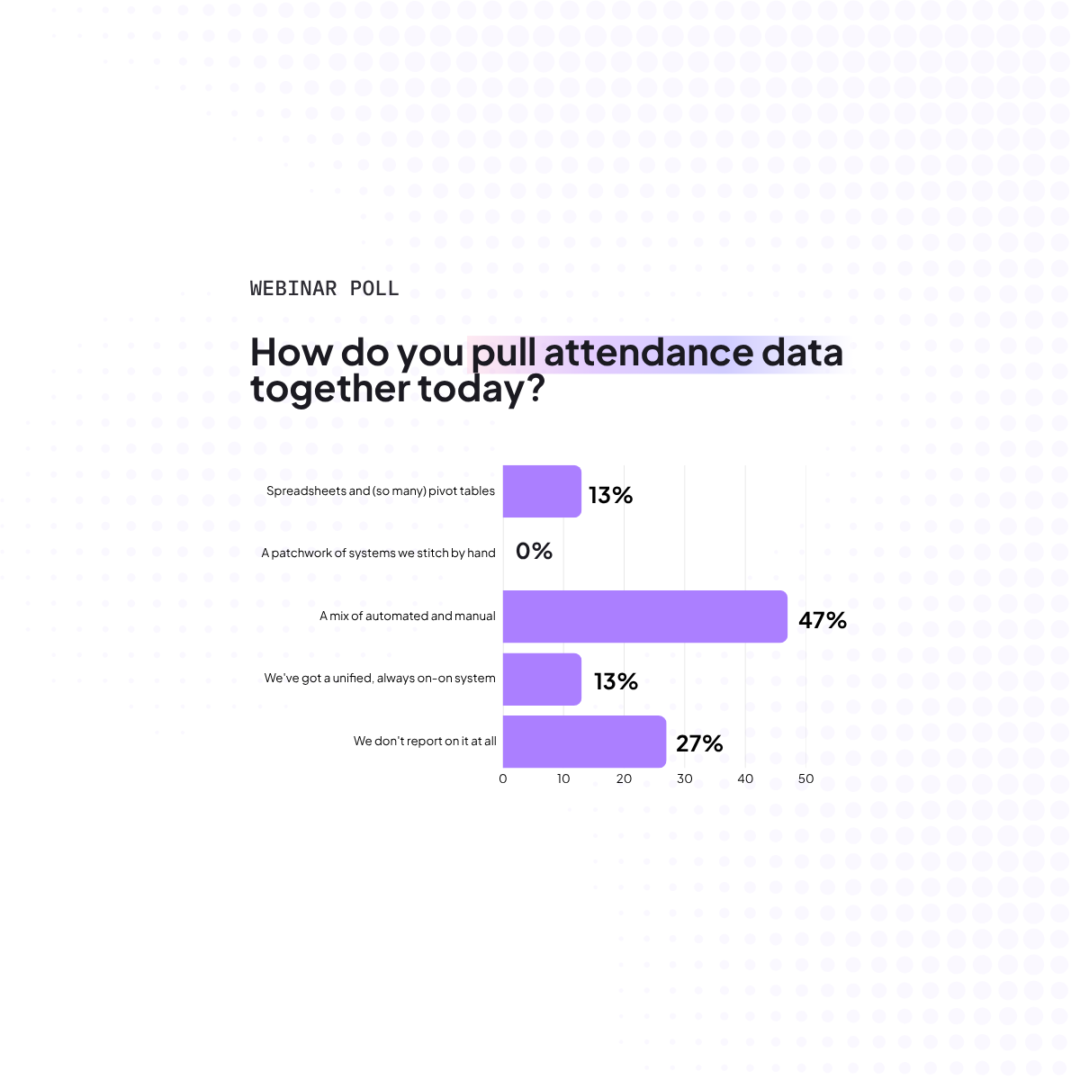
In another recent webinar poll, over a quarter of respondents reported their organization doesn’t report on attendance data at all.
How can you avoid these five points of failure when you’re designing new hybrid policies?
Turn attendance data into policies that people don't despise with this Hybrid Policy Playbook
You'll learn how to fix each of the 5 things we discussed here, how to avoid them before they happen and which data sources to prioritize.
Jackie Towers
Share this post