15 min read
How to Create an Evidence-Based Hybrid Work Policy in 2026
Most hybrid work policies fail for the same reasons. This guide explores how to build yours around real attendance and employee feedback to achieve positive measurable outcomes.

Jackie Towers
The problem with hybrid work policies
There’s a stigma around hybrid work policies. We’ve all heard of one that’s ended badly.
It might be through reading the news, diatribes from friends and family forced back into the office against their will, or subjectively worst of all – a failure within your organization.
A hybrid work policy has now become synonymous with five-day-per-week RTO mandates, leaked town hall excerpts of CEOs ranting against remote work, employee petitions thousands of signatures strong, coffee badging and a mass exodus of the most senior, skilled and diverse employees.
Why does this keep happening?
For starters, because most hybrid work policies are just a CEO’s opinion on how people should work, formalized.
The policy gets sign-off even if most of the senior leadership team thinks it’s a bad idea. It’s then communicated to the company via a contentious Zoom meeting or a memo that may or may not get leaked to the news. After a few months, everyone wonders why attendance has dropped and turnover has skyrocketed.
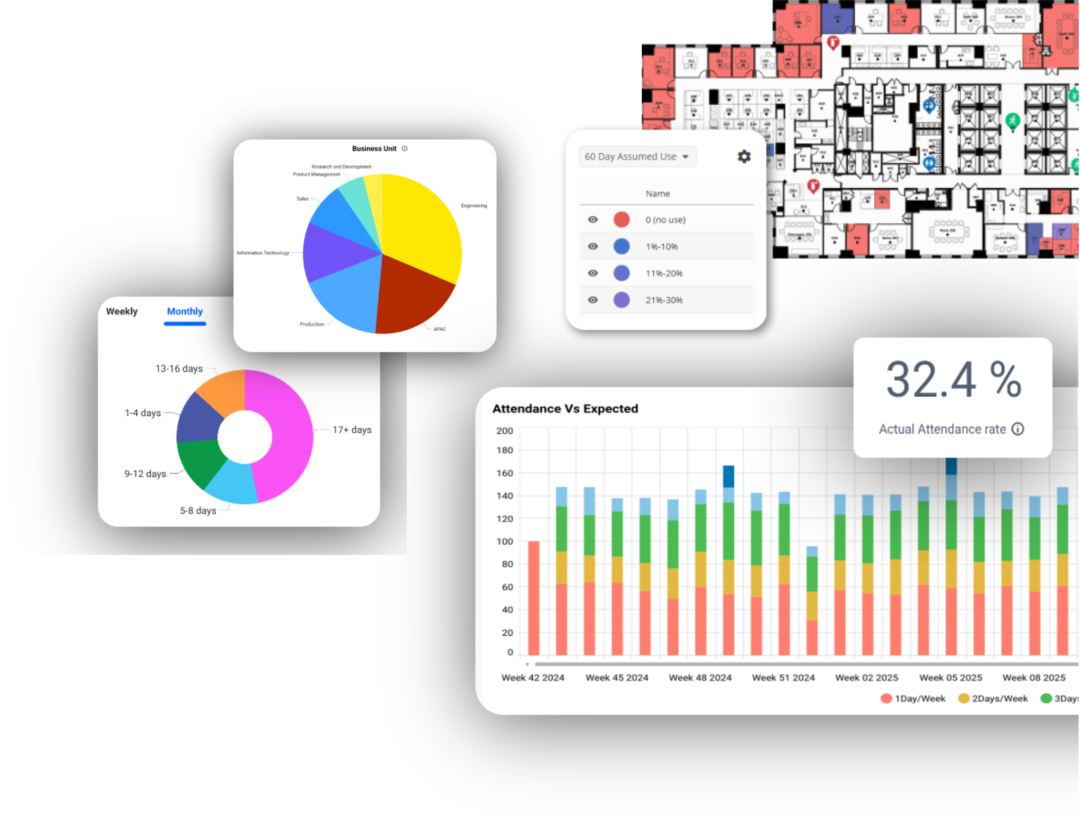
A hybrid policy that fulfills your organization’s objectives starts with data about how employees are using your spaces, what your employees actually need, and what your real estate portfolio can realistically support. From there, you build the rules, the schedules, and the communication plan around real-world constraints instead of assumptions.
This guide walks you through how to do hybrid policies well.
Hybrid work policy articles and guides
Check out these articles, guides and templates to start creating, refining and measuring your hybrid work policy.
How to use attendance data to build better policies
A guide to creating, implementing and measuring the success of your hybrid work policies
Your organization needs a hybrid policy stack, not just one
Why department and team-level hybrid work arrangements are more effective
Create more effective policies by filling in this template
Get clarity on stakeholder objectives and organizational priorities for a stronger policy foundation
How to hit the brakes before the damage is done
Get Research Professor Mark Ma's tips for experimenting with more workplace flexibility and convincing your CEO it's the right call
Find out if your policy is doomed from the start
Stakeholder misalignment, lack of autonomy for managers and "unfair" individual exceptions are just the tip of the iceberg.
With the right approach, a failure can be a competitive advantage
If your new hybrid work policy has gone pear-shaped, here's how to fix it
What is a hybrid work policy?
A hybrid work policy is an organization’s rule or guidelines stating the amount of time employees are expected to spend in the office versus working remotely. An organization’s hybrid work policy stipulates how flexible their flavor of hybrid work actually is.
At a bare minimum, a hybrid work policy should state the number of days employees are expected to spend working in the office.
To avoid all the disastrous pitfalls mentioned above, an ideal hybrid work policy should include:
- Why the arrangement exists
- The objectives it fulfills as measurable outcomes
- Who it applies to
- Which employees are eligible for exceptions/more flexibility
Your Hybrid Policy Isn't a Rulebook
It’s a visible expression of the deal between company and employees. Download this guide for more tips on creating an effective hybrid work policy and a 4 step policy-to-practice plan.

An optimal hybrid work policy aligns stakeholders on why flexible work exists within the organization, defines guardrails that help employees make their own autonomous decisions and specifies what the organization provides via the physical workplace.
When done in the most impactful and adaptive way, a hybrid work policy is a mutual and implicit understanding between employer and employee stating what’s expected (time spent in the office) and what’s provided in return (hopefully the best office anyone’s ever worked in).
Why do you need a hybrid work policy?
Surely with all the potential for disastrous consequences, the less risky option is to forego a hybrid work policy entirely?
Not necessarily.
Giving employees free rein over how much time they spend in the office might be the right call for smaller organizations with established work patterns.
But for those with physical real estate, a properly created and implemented hybrid work policy is more than a rule forcing employees to spend time in the office to snatch back ROI from the monetary cost of leases.
It can and should be a policy enshrining flexibility into the workplace’s code of conduct, preventing misalignments like:
- Inequality and favouritism between remote and in-office staff, known as proximity bias
- Managers going rogue and rolling out RTO mandates of their own
- The time and effort it takes for employees who do want to work together in the office to align their schedules, also known as a collaboration tax
And yes, at the end of the day the lack of a hybrid work policy does make it more likely that expensive real estate will sit empty. But it also makes it more likely that everyone will start coming in at the same times, resulting in the dreaded Tuesday to Thursday space shortages and the Monday and Friday ghost town.
So ultimately, an effective hybrid work policy permanently enshrines flexibility into your organization, improves workplace experience and prevents expensive over and under utilization.
The Complete Guide to Hybrid Work in 2026
Check out this guide for hybrid work best practices, strategies, tactics, technology, and most importantly – how to figure out what will work best for your organization.
Hybrid work policies vs RTO mandates
Are they the same thing? It depends.
If an RTO mandate stipulates that employees need to be back in the office full time, it’s obviously not a hybrid work policy.
When they stipulate two or three in-office days per week, these two terms mean similar things but the difference is in the delivery.
Return-to-Office has a more negative connotation than hybrid work. “The jig is up. Everybody get back to the office right now” is the insinuation most people read the term with.
But in reality there’s no “return” because it’s impossible to return to a state that no longer exists.
Despite how much we still talk about it, hybrid work is how most organizations function in 2026, and the data shows that an attempt to force things back to pre-2020 times does not end well for anyone involved.
- This study found that firms experienced no significant changes in financial performance after RTO mandates
- This study found that hybrid work reduced quit rates by 33%
- This study found that firms led by older male CEOs are more likely to mandate in-person work, reflecting “organizational or managerial preference rather than economic trade offs”
So yes, an RTO mandate may be the same thing as hybrid work in some contexts. But if you call your organization’s new policy an RTO Mandate, you should expect it to be poorly received.
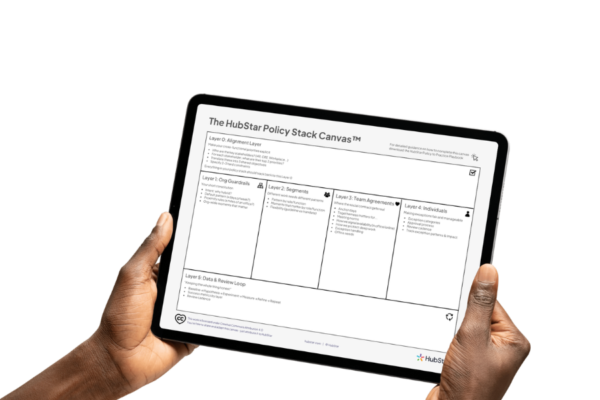
Template: The HubStar Policy Stack Canvas
Get stakeholders aligned and your organizational objectives for each of the above mapped out with this hybrid work policy creation template.
How to create a hybrid work policy
This is the part where everything can go horribly wrong. And realistically, this is where most hybrid work policies do go wrong because there’s so much room for error.
“Executives face a choice,” says Hybrid Work Expert Gleb Tsipursky. “They can pursue badge-driven control that fails to raise performance and risks losing their best people, or they can treat flexibility as a strategy, design for trust and clarity, and measure what matters.”
Transcribing the CEO’s factually unsupported view (everyone should be in the office) directly into a policy is the most common failing point, because it skips gaining clarity and alignment. This needs to happen at each layer of the organization before the figurative pen hits the figurative paper.
These layers include:
- Organizational alignment – identify stakeholders (HR, CRE, C-Suite) and align objectives
- Organizational guardrails: identify why people should be in the office and what they’ll gain from it
- Alignment on work patterns: align different work roles and functions with ideal in-office/remote work patterns
- Team-level agreements: give teams the autonomy to decide on their specific hybrid work agreements
- Individual exceptions: scope out what necessitates exceptions and how they’ll be handled fairly

How to manage hybrid work policies across teams
An effective hybrid work policy consists of multiple hybrid work policies within broad organizational boundaries.
That’s because no department, team or even individual works in the same way.
For some roles, the best work happens without distractions (that include colleagues) while for other roles it’s a necessity to work beside colleagues twice a week.
That’s why you need multiple hybrid work policies, or in other words, a hybrid policy stack.
In the phase of your policy creation where you establish organizational guardrails, you might establish a minimum viable time employees should spend in the office, or a core set of reasons why in-office work is beneficial.
But this changes considering organizational dynamics. So ideally, you’ll have a cohesive stack of policies that reflect different working patterns and give individual managers the autonomy to decide on the right ways of working for their teams.
This last point is a critical one if you want to avoid hybrid policy failure. It’s no surprise that 40% of managers ignore policy non-compliance from their direct reports. Enforcing hybrid work policies they don’t agree with is also a cause of declining manager engagement, which has fallen to only 22%.
“Why is some guy who is three levels above me dictating how I run my team?” a manager who was anonymously interviewed in a 2025 study on the impact of RTO mandates commented. “I feel like this is something we should be talking to the actual people leaders who are managing the nitty gritty day to day life.”
If your organization isn’t intentionally creating a hybrid policy stack, a disconnected, unintentionally created set of policies is already evolving.
Why You Need Multiple Hybrid Work Policies
One rigid hybrid work policy to rule them all does not end well for most organizations. Here’s why you’ll need multiple hybrid work policies and how to manage them without losing your mind.

How to get leadership buy in
Organizational trust and engagement falls apart when workplace leaders have to comply with a policy they don’t agree with. Diplomatically holding the company line on a policy the CEO thought was a good idea is mentally taxing enough. But when you’re walking into the boardroom with the difficult job of reporting that the mandate has had zero impact on attendance? Yikes.
The better alternative is workplace leaders coming together early on to get aligned on departmental priorities and get buy-in from the C-Suite. This is easier said than done and depends hugely on the CEO’s mindset and worldview.
But is there anything you can do to get a CEO who’s pro-hard line RTO mandate to reconsider?
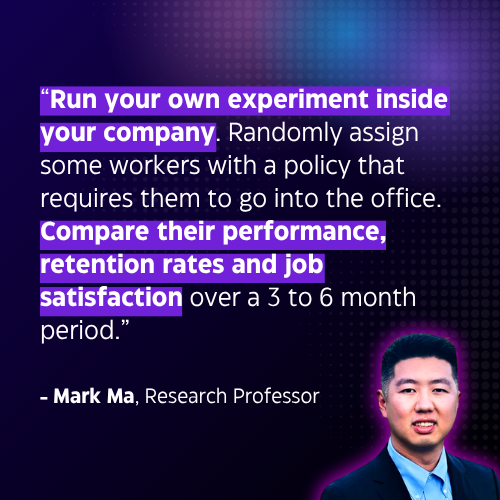
According to University of Pittsburgh Research Professor Mark Ma, highlighting examples of successful organizations with flexible policies is a great way to give your business case more credibility.
Another is to “run your own experiment inside your company. Randomly assign some workers with a policy that requires them to go to office. And then compare their performance, retention rates and job satisfaction over a 3 to 6 month period.”
Can You Change Your CEO's Mind About RTO Mandates?
In this excerpt from HubStar’s Workplace Visionaries podcast, Jane chats with University of Pittsburgh research professor Mark Ma about whether it’s even worth trying to change a CEO’s mind pre-RTO mandate.

How to communicate hybrid work policies
The way your policy is communicated determines how it will be received. And the more employees feel like their preferences and concerns have been heard, the more likely they are to comply with the policy.
Over half of employees in this study, for example, preferred a hybrid work schedule of two days in the office per week.
The onus is on workplace leaders to open up feedback channels. When this doesn’t happen, the policy is more likely to fail and trust in leadership is guaranteed to falter.
In this study on the impact of RTO mandates, employee interviews revealed decreased trust in leadership and “incongruence between the values of the organization with the RTO policy.”
“I feel like I’ve put in a lot to this company. I’ve put in a lot of hours. I’ve put in, you know, all the hard work that I’ve done, and I think we’re not being heard,” an employee commented in an interview.
One survey isn’t enough to make people feel heard, although it’s a start. Instead, ask people for feedback continuously and highlight what’s been done differently as a result.
“Some of the best ways I’ve seen change adopted in large-scale, highly matrixed, bureaucratic organizations is when leaders don’t just sell the change themselves, but allow people to sell it back to them,” says Mika Cross, Workplace Transformation Strategist. “That might look like smaller test beds where you’re also equipping managers and team leaders to ask the right questions and institute rituals. For example, inviting teams to give their top five reasons why this change initiative could fail, or designing countermeasures to offset the reasons why people feel like it may fail.”
How to Make Workplace Change Stick: Real-World Examples
In this excerpt from HubStar’s Workplace Visionaries podcast, workplace transformation strategist Mika Cross shares real examples of what makes and breaks workplace change initiatives.

Why hybrid policies fail
What counts as a failed hybrid work policy? Is it just employees ignoring the policy?
This can be a symptom of failure, but it goes a lot deeper than that.
At a high level, a failed hybrid policy doesn’t achieve its objectives. This is why it’s so important to get aligned on objectives before rolling out your policy.
For example, if your hybrid work policy’s objective is increasing revenue growth, and revenue growth declines, the hybrid policy has failed.
What else constitutes a hybrid work policy failure?
- Attendance stays the same or decreases
- Churn rates increase
- Employees sign protest letters or go on strike
- There’s not enough space or resources to support the number of employees working in the office
- Employee satisfaction scores decrease after the policy is issued
- Performance, profitability and revenue growth decline decisively after policy implementation
Here are a few real-world examples of (very public) hybrid work policy failures:
Ubisoft’s early 2026 post-RTO mandate strike
In February 2026, French video game developer Ubisoft issued a five-day RTO mandate without prior consultation with employees or unions, at the same time as a 200 million cost reduction and a headcount reduction of 200.
Employees in France staged a three-day strike and employees in Montreal picketed in solidarity.
The US Federal Government’s post-RTO mandate lack of space
In January 2025, all US Federal Government employees were ordered back into the office with a full-time RTO mandate. Employees reported not having enough space to take calls, plummeting productivity and even no working internet.
Dell’s inconsistent RTO mandate enforcement
In March 2025, Dell ordered employees back into the office five days per week. Employees reported unequal enforcement of mandates across teams, and working parents reported not being allowed to leave early for childcare.
5 Reasons Why Hybrid Work Policies Fail
If your organization’s hybrid work policy is about to go up in smoke, it’ll probably self-combust for one of these five reasons, and none of them involve “people just don’t want to work in the office anymore”.

How to fix a failed hybrid policy
If your organization has rolled out a hybrid policy that’s flopped, all is not lost. Whether it’s plummeting engagement, decreasing retention or a mandate making the headlines that you’re trying to avoid, a fix is possible with the right approach, but you’ll need to take decisive action now.
Unfortunately, workplace leaders are usually the ones left trying to pick up the pieces after a policy failure instead of the C-Level executives who insisted it was a good idea. The combination of saving face for the organization with the conviction that the policy was doomed to fail is a lot like stepping in a puddle with socks on before you leave for work.
But fortunately, transparency, humility and openness about not having all the answers goes a lot further than you might think.
This experimental study found a positive correlation between leadership transparency and employee trust during difficult events like a layoff. It concludes that “followers who perceive their leaders to be transparent and positive seem to trust them and judge them to be effective in leading them through challenging times.”
This large-scale survey found that authentic leadership and transparent communication increase trust both directly and indirectly.
“The linking node between authentic leadership and engaged employees resides in communication. Transparent communication has become a vehicle for authentic leaders to demonstrate their core leadership traits.”
And this study found empirical evidence that supports leader humility as boosting employees’ positivity towards their own work and decreasing negative behaviors directed at leaders.
So bearing in mind that leadership authenticity, transparency and humility have been proved to build trust, here are four steps to fixing a failed hybrid policy:
- Step 1: Reality check
- Step 2: Quantify the impact
- Step 3: Emergency adjustments
- Step 4: Collect feedback and adapt
Failed Hybrid Policy Guide: From Crisis to Competitive Advantage
If what you feared has indeed come to pass and that new policy hasn’t fulfilled its objectives, all hope isn’t lost. In this guide, we’ll cover what to do, real-world examples of failure, how to create and implement policies that actually stick, and red flags that a crisis is around the corner.

How to measure the success of your hybrid work policy
There are both quantitative and qualitative ways to measure how your hybrid work policy is performing over time.
Quantitative ways include:
- An increase in attendance that stays consistent over time
- An increase in space utilization rates (demonstrates how employees use zones and neighborhoods)
- An increase in employee NPS
- A measurable reduction in churn rate
Qualitative ways include:
- Improvements in feedback about collaboration quality
- Improvements in employee sentiment about their jobs and sense of belonging
- Improvements in employee wellbeing including less burnout, reduced absences from illness and so on
An improvement could be something as simple as a few watercooler conversations you overhear.
But targeted surveys about meeting quality and collaboration, sentiment analysis of feedback on employee surveys and feedback from weekly manager check-ins are all valid ways to measure qualitative improvements.
Something that’s always changing requires continuous measurement, and your hybrid work policy is not the exception to the rule.
Organizational and team objectives are always changing and ways of working naturally flex to support that.
Accurate measurement is a cycle of:
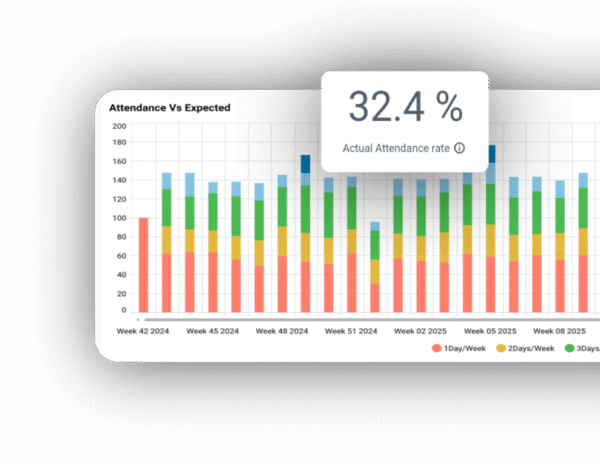
- Looking at baseline data. Attendance and space utilization data show how people are showing up and using the workplace
- Proposing hypotheses. E.g. “Marketing averages 1.8 days against a three-day policy. Let’s drop it to two and reallocate their seats.”
- Running the experiment. Small scale pilots work best and are easiest to reverse
- Measuring the results. Compare to the original baseline data
- Refining hybrid work policies. Now they’re based on real findings from within your organization

The data you need to create hybrid work policies
Even the best hybrid policies fail when they’re disconnected from organizational reality. The only way you can measure reality is through attendance data.
The objective here isn’t to punish people who aren’t following the policy. This is another big reason policies fail and why people aren’t receptive to new ones. No one wants to be big-brothered.
Attendance data is the basis your hybrid work policy is built on. It’s also the way you measure its success.
So without the right data, you can’t create your policy in the first place or measure how it’s doing.
Here’s the data workplace leaders need to gather:
- Badge swipe data from IT
- Badge IDs from HR
- Neighborhood and desk assignment data from HR systems
- Space utilization data from occupancy sensors, WiFi and booking systems
- PTO and holiday data scattered across individual teams
- Data on policy exemptions in individual manager’s minds
- Floorplans for extrapolation whether new policies can fit everyone into the same space

That leaves you with at least seven different people and systems to get data from. You’ll then need to compile it in a giant spreadsheet and keep it updated regularly.
Ain’t nobody got time for that.
Moosh all that data together instead
Attendance and occupancy are constantly changing, and the boundaries of your hybrid work policy need to be flexible enough to encapsulate that.
Dynamic occupancy has now entered the room and has plopped itself down as the elephant in said figurative room.
So organizations need a new system that pulls together and analyzes:
- Badge swipes
- HR data
- PTO and policy exception data
- Business unit data
- Floorplans

Fortunately, such a system already does exist, and we’ve called it HubStar Policy Pulse. Policy Pulse is part of HubStar’s dynamic occupancy solution, Hub, which is a system of record for HR data, business units, working days and times, closures, PTO, space data, floor plans, seating assignments. No more retrieving data from seven different sources and spending hours every week on the giant spreadsheet of doom.
Find Out If Your Hybrid Policy Is Working with HubStar Policy Pulse
Get rid of data siloes, impossibly complex spreadsheets, empower managers to decide on the best hybrid work agreements with their teams and create policies that adapt with organizational change.
Key Takeaways
- Executive preferences are not a foundation for an effective hybrid work policy.
- Organizations need multiple hybrid work policies.
- Hybrid work policies fail when they don’t achieve organizational objectives, but that can look catastrophic or insidious.
- Hybrid policy success depends on the way it’s communicated.
- You can’t create or measure a hybrid policy without the right workplace data and chances are it’s fragmented.
Get actionable tips for hybrid strategies and workplaces in these guides:
Hybrid Policy vs Reality Playbook
Using attendance data to evolve Your workplace strategy
The HubStar Hybrid Policy Stack Canvas
Map out your policy's priorities, objectives and stakeholders
HubStar can help you build, manage and improve your hybrid workplace.
Check out our blog and guides for practical steps and insights to make hybrid work.
Jackie Towers
Share this post