5 Hybrid Work Trends for 2026
Another year (almost) over and a new one about to begin. It's time for our yearly predictions on hybrid work trends for 2026!

Jackie Towers

As far as hybrid trends go, 2025 was the year of experimenting. Companies issued more return-to-office mandates and actually implemented the ones they created in 2024.
Now the data caught up with us and confirmed what we already suspected. Hybrid work is the default work model and the majority of people are happy with it.
67% of organizations are using some form of hybrid work, with an average of 3.74 days spent in the office. 73% of employees think hybrid work makes them more productive and companies that use it see a productivity boost of 11%.
Despite what the headlines are saying, only 12% of hybrid companies plan to get everyone back in the office full time.
But as long as forced RTOS keep happening, allegedly because it makes everyone more productive and connected, it’s likely we’ll still talk about hybrid work like it’s still something novel and contentious.
So with that in mind, here are five hybrid work trends we predict we’ll be seeing more of this year.
The Complete Guide to Hybrid Work in 2026
Get the latest data, pros and cons, 5 steps to creating a hybrid work strategy, tips on creating hybrid policies and the tech, tools and processes you need to get it all right in this guide.

1) Assigned seating won’t be the default anymore.
For all the full-time RTO headlines making the news, desk plants and family pictures won’t be making a permanent comeback any time soon.
Assigned seating has been on the decline every year, down to 25% of companies surveyed by CBRE from 40% in 2024. This seems like a direct result of flexible work policies but also opens up a chicken and egg question – does hybrid work drive the rise of flexible seating because it’s more cost effective, or does prioritizing cost effectiveness drive the growth of flexible seating?
Whatever the answer, companies are ramping up their ratios of employees to shared desks, with 73% surveyed by CBRE expecting theirs to be more than 1.5:1 by 2027.
Most companies expect flexible spaces to remain at 25% or less of their portfolio, however, with cost and employee perception being the biggest obstacles to adding more.
A move away from assigned seating opens up a whole new world of activity-based working. If people aren’t sitting in assigned desks all day, they’re free to move around depending on what their mood is and what they want to achieve, like private focused work, informal collaboration or an impromptu presentation.
That’s not to say assigned seating is becoming obsolete. Many organizations have found that allocating assigned desks to people willing to come into the office more frequently is an effective way of boosting attendance and giving people control over their work environment.
On the flipside, flexible seating has the benefit of exposing people to colleagues they wouldn’t usually see if they just headed straight for their usual desk every day.
Some organizations are using flexible and bookable desks as a way to boost office attendance without rolling out a hard line mandate, using the natural magnetism of wanting to sit near a manager or favorite colleague.
4 Data-Driven Hybrid Office Design Tips for 2026
Office design is complicated enough, but adding hybrid to the mix has many companies stumped. Here are 4 ways to use data to power your hybrid office design.

2) The real consequences of hard line RTO mandates will become apparent.
Forcing everyone back into the office full time makes for a catchy news headline, but the reality is quite different.
There’s a difference between a policy and theory and a policy in practice, which is what we’ve seen over the last year.
Dell has mandated everyone who lives within an hour of the office back in 5 days per week. Microsoft is rolling out a three day mandate in early 2026. Starbucks rolled out a four day in-office mandate, despite their CEO famously still being permitted to work remotely.
The data paints a different picture. One in five employees ignore RTO mandates, and 40% of managers don’t enforce them. A May 2025 study found that only 42% of employees would comply with a five day RTO mandate. The percentage of employees who would immediately look for a new job has doubled, from 5% to 10%.
Studies over the last few years have shown that RTO mandates decrease job satisfaction and cause a disproportionately high number of senior and skilled employees to leave.
A FlexIndex report from 2023 found that companies with flexible work policies outperformed their inflexible peers by 16 percentage points of industry-adjusted revenue growth.
So why are RTO mandates still a thing despite all this evidence?
One of the answers could be that the C-suite is reverting back to the status quo way of keeping eyes on people’s so-called productivity – literally having eyes on them at all times.
“Productivity is very difficult to quantify, let alone measure,” says organizational psychologist Dr. Craig Knight. “This is why a lot of organizational leaders are reaching for mandates and counting hours and days in the office.”

Find out more about why it’s time to rethink the traditional definition of productivity on the Workplace Visionaries podcast with Craig Knight.
Rethinking a measure we’ve relied on for decades is not quick or easy. But it’s necessary one.
What we know so far is that the benefits of RTO mandates are scant, while the negative impacts are quantifiable with the main ones being:
- Decreased job satisfaction
- Decreased organizational performance
- Higher churn rates of skilled employees
- Damaged trust in leadership for employees and managers alike
- Little impact on office attendance frequency
- Not enough space and/or resources to have everyone in the office (like Amazon experience first hand)
In 2026, we’ll continue to see the negative impacts of RTO mandates, although they might not always make the headlines.
3) Quality of workplace experience will determine hybrid policy compliance.
When it comes to office attendance, a free-for-all just isn’t practical. Most people do want to spend some time working in the office, as long as it’s with a frequency they think is reasonable and presents a tangible benefit.
A positive workplace experience creates positive views of the workplace, making it more likely that employees will comply with hybrid work policies (especially when they’ve had a say in their creation).
“Employees with a positive view tend to work in environments where business needs are balanced with employee wellbeing,” JLL’s 2025 Workforce Preference Barometer states. “They benefit from quality workplaces, an empowering managerial culture and learning and development opportunities.”

50% of employees with a positive view of their organization’s hybrid work policy think in-office work supports better teamwork. On the flipside, those with a negative view of their organization’s hybrid policy say they’ll be less productive if they can’t choose their work environment.
It seems logical that the better the workplace experience, the more people will come into the office.
What’s different now is that we have the data to prove it. The task facing hybrid organizations in 2026 is figuring out what layouts, designs and amenities create that positive workplace experience. Work that into workplace design, and you’ll see attendance and hybrid policy compliance skyrocket.
Autonomy is a critical part of workplace experience, and one that too many organizations have ignored. Employees will be far more likely to comply with a hybrid work policy if they feel like they have some degree of self-determination in the process of deciding how it should work.
31% of employees surveyed by Gallup say their employer determines their hybrid work schedule, 34% say they have full control over their hybrid work schedule, and 35% say it’s decided by their team. 91% of employees who say their hybrid policy is a team-level agreement think it’s fair, compared to just 73% of employees who have absolutely no say.
This 2025 international study identified between six to ten days per month in the office as the sweet spot for hybrid work.
Could an exceptional workplace experience that offers people everything they need to suit every mode of working – collaboration, quiet focus, exposure to mentoring and leadership – increase this number?
We’ll soon find out.
Failed Hybrid Policy Guide: From Crisis to Competitive Advantage
In this guide we cover why hybrid policies flop, what to do if this happens to your organization, real world examples and steps you can take to make it right.

4) The workplace wellbeing gap between flexible and non-flexible organizations will widen.
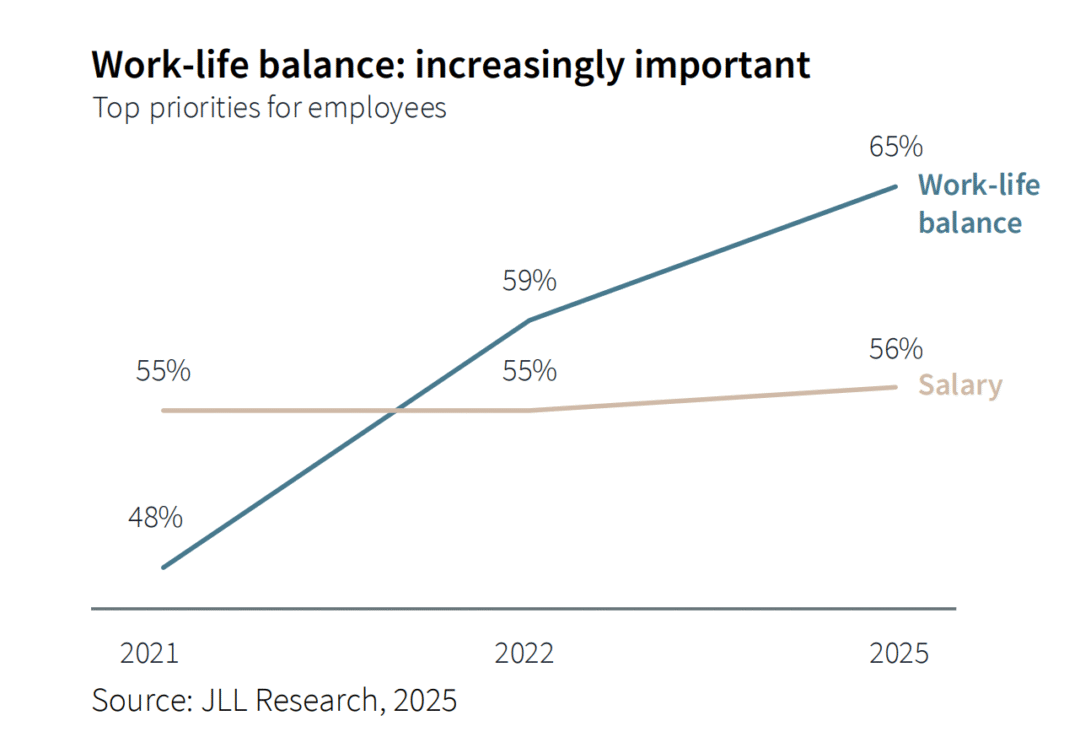
Employees aren’t shy to make it known that they value their wellbeing over other motivators like salary and prestige. 65% of employees surveyed in JLL’s Workforce Preference Barometer ranked work/life balance as their biggest priority, outranking salary at just 56%.
Four in five said hybrid working has had a positive impact on their mental, physical, social and financial wellbeing, according to a July 2025 survey. But over a third of those surveyed said headlines about RTO mandates were negatively affecting their wellbeing.
It could be this apprehensive climate that’s causing global employee engagement to fall in 2025, costing US $438 billion globally. Interestingly, the biggest decline in engagement levels since 2024 was amongst middle managers, the ones who have to enforce RTO mandates they may not necessarily agree with.
If flexibility and workplace wellbeing are now inextricably linked, the divide between companies that offer it and ones that don’t will become increasingly apparent. And considering that RTO mandates cause more senior, talented employees to leave, companies that maintain a flexible work policy may well see themselves pull ahead in performance as well as wellbeing.
5 Ways to Improve Workplace Wellbeing
In this post, we cover a definition of workplace wellbeing that isn't too woo-woo, plus 5 ways to improve it that aren't plants and annual talks about the importance of mental health.

5) Successful hybrid organizations will revamp their workplace data and processes.
The theme of 2025 has been figuring out that some things just aren’t matching up, whether that be:
- Policy expectations vs actual attendance
- Leadership vs. employee perceptions of workplace culture
- RTO mandates vs the lack of sufficient office space to support everyone being in at the same time, a la Amazon in early 2025.
Workplace data is the way to eliminate this gap, and fortunately it’s something that many organizations are working towards improving.
Whether it’s measuring which teams are actually showing up or which neighborhoods are close to capacity, workplace data is the concrete starting point for improving the office’s experience, cost-effectiveness and sustainability.
Existing systems aren’t up to scratch though, considering how rapidly things change in a hybrid workplace. Take space planning for example – back in the day, floor plans might change annually. These days some organizations update their floor plans every couple of weeks.
Manual edits and markups of PDF and paper floorplans are still the status quo, according to JLL.
This is bad news because the status quo is “limiting update frequency and accuracy while potentially impacting the quality of decision making.”
That’s why 22% of organizations are looking into options to revamp their space planning processes in the near term.
A few years ago, there was little alignment on which metrics to track. That’s not the case anymore. 89% of organizations agree that space utilization is the most important group of metrics for space and hybrid program planning, for example.
5 Office Space Utilization Metrics for a Better Workplace in 2026
Which space utilization metrics should you be tracking for hybrid success in 2026? With outcomes from fairer hybrid schedules to improved space allocation, these 5 metrics are the ones to add to your roster.

What’s missing is the data broadness and granularity to support measuring these metrics in a way where workplace leaders can use them as a basis to make the right decisions, however.
Ultimately the task facing hybrid workplace leaders is figuring out how to allocate the right spaces to the right people to deliver the best experience at the lowest cost.
If your systems can’t manage the detail that lurks beneath the surface – from policy exceptions to paid time off to office closures – what seems like a compliance failure may be a false expectation set by inaccurate data.
90% of organizations use badge swipe data as the primary method of measuring space utilization, which doesn’t give any insight on what people are doing once they’re inside the office.
Badge swipes measure occupancy – a yes/no answer to whether people are in the office – not space utilization, which answers how people are using the space.
So in 2026, we’ll see forward-thinking organizations revamp how they measure workplace data, which in turn provides the basis for revamping key workplace processes and building a better workplace.
Take it from JLL, again:
“Organizations with advanced data capabilities gain significant advantages in space allocation, pattern identification and ultimately portfolio optimization.”
Global Occupancy Planning Benchmark Report, 2025
JLL
Bring Your Hybrid Work Objectives to Life in 2026 with Dynamic Occupancy Planning
Download this guide to find out how dynamic occupancy planning - aka planning for the constant change of hybrid work - can help you achieve your workplace objectives in 2026.
What’s been true for the last five years is still true today. Workplace leaders willing to admit they don’t have all the answers or certainty about how everything will work out are ultimately at an advantage.
That might sound counterintuitive. Doesn’t a leader have complete conviction that the course of action they’re taking is the right one?
Not this year, and not when it comes to hybrid work.
Admitting you don’t have all the answers and that you don’t have the level of omniscience required to see if something will be a success means you’re more likely to rely on evidence before making a decision, whether that’s space utilization data or data from an employee survey.
Transparently acknowledging that something is a work in progress builds trust and makes people more likely to speak up when they feel something’s off instead of letting the resent fester and look for another job.
And finally, admitting you don’t have all the answers means you’re always evaluating the performance of what you’re trying to achieve. Whether that’s a new hybrid policy or using AI in a new way, constant evaluation keeps your company agile and means you can quickly change course if something’s not performing the way it should be.
The willingness to be open about not having all the answers will make the difference between success and failure for hybrid organizations in 2026.
Jackie Towers
Share this post
Similar posts