HubStar Brings AI-Powered Dynamic Planning to Corporate Real Estate
Our latest release, HubStar Dynamic Planning, combines live workplace data, AI-powered optimization and automation to replace periodic, manual planning with continuous strategic decision-making and execution.

HubStar
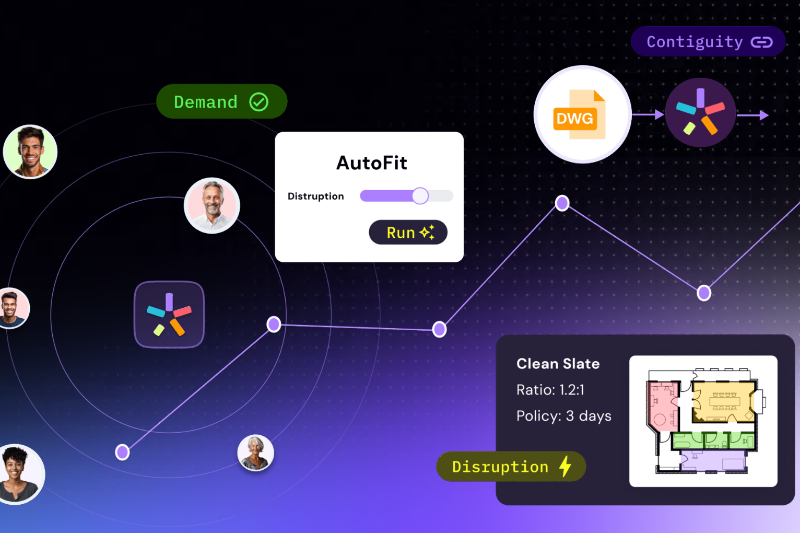
Dynamic Planning combines live workplace data, AI-powered optimization and automation to replace periodic, manual planning with continuous strategic decision-making and execution.
Today we are proud to announce the launch of HubStar Dynamic Planning, a new strategic occupancy planning capability designed to transform how corporate real estate teams understand employee demand for space, model change, optimize space and turn decisions into action.
The workplace never stands still. Most planning processes still do.
Teams grow and shrink; hybrid policies change; attendance varies by day, team and location. Reorganizations, acquisitions and lease events can alter demand overnight. Yet occupancy planning is still often built around periodic exercises, assumptions that no longer apply, fragmented data and manual processes that can take weeks or months to produce an answer.
HubStar Dynamic Planning changes that operating model.
Organizations can maintain a living view of demand, space allocation and actual attendance; test scenarios in seconds; solve complex allocation and restacking problems across buildings and floors; and carry an approved plan through to execution.
The launch comes as corporate real estate leaders face growing pressure to become more responsive, data-driven and strategic. Across the enterprise, AI is compressing the distance between information and action – raising expectations that every function can respond faster, model alternatives more intelligently and adapt without starting again from scratch.
Yet despite years of investment in workplace systems and data, CRE still faces a significant gap between measurement and decision-making.
JLL reports that data-driven real estate decision-making has shifted from a competitive advantage to a baseline requirement. Utilization is now applied to planning decisions by 90% of organizations, while improving space data accuracy has risen to become the #2 corporate real estate priority.
But the underlying data environment remains far from solved. Only 7% of organizations rate their occupancy data capability as excellent, while workplace information commonly sits across CAFM platforms, reservation systems, badge feeds and HR records maintained by different teams, with different definitions and frequencies.
CBRE identifies the same disconnect. Ninety-five percent of organizations use a space data management system and 94% have automated inbound data feeds, yet Microsoft Excel remains the primary analysis tool for 48%.
The issue is no longer simply collecting more workplace data. It is giving that data enough context to support decisions – and making those decisions quickly enough to matter.
“Corporate real estate has spent years becoming more data-rich. The next step is becoming more decision-capable,” said Steve Vatidis, Executive Chairman, HubStar.
“Workplace teams are being asked to make increasingly complex, high-value decisions while still relying on processes designed for a far more predictable world. Dynamic Planning gives workplace leaders a fundamentally different way to operate.”
Steve Vatidis
Executive Chairman
From data to decision
HubStar Dynamic Planning brings together the major stages of the occupancy planning cycle in one connected environment.
Its Flow capability turns complex supply and demand into a clear visualization – allowing planners and executives to align around a common understanding of what people are expected to need, what has been allocated and what is actually happening – from campus or metro level down to individual teams.
Rather than depending on periodic, spreadsheet-based business unit forecasting exercises based largely on headcount, demand can be derived continuously from workforce, organizational and workplace policy data. The result is a living demand model that changes as the organization changes.
Dynamic Planning then applies intelligent automation to one of the most labor-intensive areas of traditional occupancy planning: stacking and blocking.
Built on HubStar’s portfolio of patented AI technology, Fit&Fill and AutoFit enable buildings, floors and spaces to be optimized in seconds, while planners retain control over assumptions, disruption levels and final outcomes.
Scenario planning also moves from an occasional exercise to an everyday decision capability. Organizations can model the impact of a hybrid policy change, business unit growth, different sharing ratios, lease events or releasing space – and compare alternatives without rebuilding the entire planning process every time something changes.
Instead of spending their time solving the mechanics of the space puzzle, planners can focus on the questions that require human judgement: which assumptions to test, which trade-offs matter and which course of action best supports the business.
From decision to action
Unlike traditional processes that effectively end once a plan is approved, HubStar Dynamic Planning connects strategy with execution.
Approved plans can flow into the operational workplace, linking strategic decisions with changes to floorplans, neighborhoods, assignments and the systems employees ultimately use to find colleagues and space.
HubStar estimates that Dynamic Planning can eliminate roughly 90% of the low-value mechanical work involved in the traditional planning cycle.
That elevates the occupancy planner from space puzzle solver – manually manipulating spreadsheets and entering data – to strategic decision-maker.
“This is about moving occupancy planning up the value chain,” said Vatidis.
“If leadership asks what happens if attendance increases, if a business unit grows by 20%, if an acquisition lands or if a floor needs to be released, the answer should not take three weeks and six spreadsheets.”
“Workplace leaders should be able to understand the implications, model their options and make a decision while the question is still live.”
Steve Vatidis
Executive Chairman
An intelligent foundation for workplace decisions
HubStar Dynamic Planning is the latest addition to HubStar’s H2O platform, alongside space management, workplace experience and utilization intelligence.
H2O connects strategic planning with the space, people, policy and occupancy intelligence required to support it.
That foundation is critical to effective workplace AI. Optimizing a workplace requires more than an algorithm: it requires reliable context about the relationships between people, teams, spaces, policies, allocations and actual behavior.
JLL says organizations investing in data quality today are building the infrastructure for the next generation of intelligent real estate strategy. HubStar’s approach follows the same principle: AI and optimization depend on a trusted workplace data foundation.
“The quality of the decision can never be better than the quality of the data beneath it,” said Vatidis.
“The future of corporate real estate will not be defined by who has the most dashboards or data sources. It will be defined by who can turn trusted intelligence into action fastest.”
HubStar Dynamic Planning introduces a new operating rhythm for occupancy management: continuous planning, decision-making and execution.
“The future of corporate real estate will not be defined by who has the most dashboards or data sources. It will be defined by who can turn trusted intelligence into action fastest.”
Steve Vatidis
Executive Chairman
For CRE leaders, that means more than efficiency. It creates an opportunity to move beyond reactive cost management and play a more strategic role in business performance, organizational change and capital allocation.
“Corporate real estate controls one of the largest cost bases in the enterprise, but its strategic potential goes far beyond cost,” Vatidis concluded.
“HubStar Dynamic Planning gives workplace leaders the intelligence and tools to move from reacting to change to helping shape it.”
Explore HubStar Dynamic Planning
Occupancy planning has been broken for decades: a manual, annual scramble for a workforce that changes every week. Nobody built a tool that plans occupancy dynamically, end to end. Until now.
HubStar
Share this post