Using employee surveys in workplace design
The Pros and Cons of Using Employee Surveys in Workplace Design with Deborah Simmons
In this excerpt from the latest episode of the Workplace Visionaries podcast, Jane chats with Strategic Insight Consultant Deborah Simmons about the values and limitations of using employee surveys as a data source before you start a workplace design project.

Jackie Towers
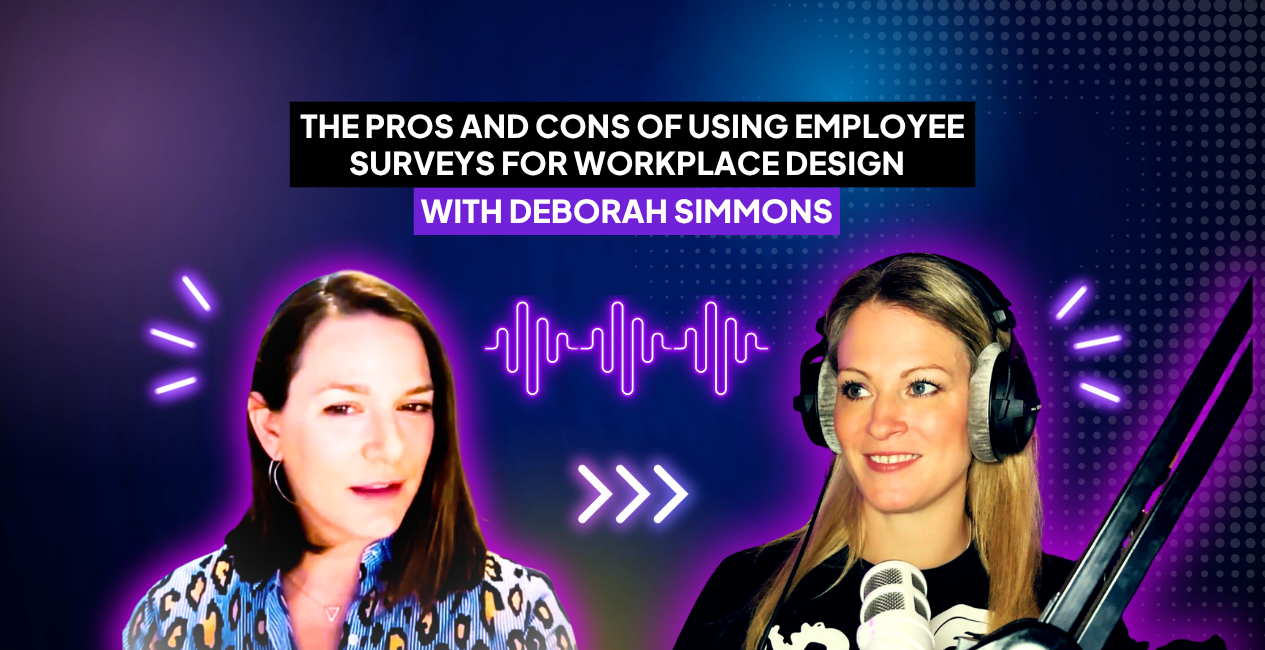
In episode 8 of Workplace Visionaries, Jane sat down with Deborah Simmons, Strategic Insight Consultant about what listening before designing really means in the research context, the pros and cons of employee surveys, and how Deborah applies her background in behavioral research and UX into workplace design.
Jane Young: We published our HubStar Hybrid Occupancy Index not long ago, and in that data we could see that there’s quite a lot of offices that aren’t quite hitting the mark in terms of that fitness for purpose. For example, there was a lot of evidence that people really crave more private space, and this was showing up often in poor utilization efficiency. Individuals, or maybe a couple of people, are hogging these big meeting rooms because they can’t find a suitable space to make calls or focus on deep work. I also saw Leesman’s data that said the average home experience scores higher than the average office experience. They were pointing out how common it is that workplaces don’t have the basics right. So things like noise, lack of quiet space, poor temperature control, weak amenities, maybe even desks and chairs that aren’t good enough. So what do you think is going on there? Why are so many workplaces failing to hit the mark on some of those fundamentals of a decent experience?
See meeting room usage data from 300 million square feet of office space
Download HubStar's Hybrid Occupancy Index for more weekly occupancy trends, why 80% of meetings happen in small rooms and more.
Deborah Simmons: If I could change one thing about workplace strategy and design, it would be to get people to listen more, earlier. So to listen, to be curious, and to be open. So it’s much easier to listen first and then design when you’re fully informed, than to design first and listen later.
Jane: Would you say that the voice of the end user is a little bit absent then in workplace design, a lot of the time?
Deborah: I do feel that. I have conversations with people about this on a daily basis, from a design or strategy point of view, from a business owner point of view, and from the end-user point of view. I will never miss an opportunity to ask people, because I want to understand and find the answers. And whilst I do appreciate there are the realities of tight timelines and budgets, especially for architects, often people feel that research has to be a very long, drawn-out and expensive process, it doesn’t have to be. There are workplaces that do some consultation with end users at the beginning, but I think in a lot of cases it’s limited to an employee survey or a steering group. I know there are cases where it does go a lot deeper than that, and I think that’s to the benefit of everybody involved. But yes, I do think there is a limit to what’s being done, and I think that has consequences.
"If I could change one thing about workplace strategy and design, it would be to get people to listen more, earlier."
Deborah Simmons
Strategic Insight Consultant
Jane: Downstream, you can see that if you skip over the proper end-user research at the front end, then albeit you might have saved a little bit by doing that, but it will bite you later, and you won’t actually have a saving overall, because of that lack of understanding and maybe relying on just a brief survey that doesn’t really do the job.
Deborah: Surveys are great for what they’re designed for, which is giving a bigger picture. You get the lay of the land with a survey, you don’t necessarily understand the why behind the data. So if you’re looking at some employee data from a survey, and you ask yourself what’s driving this, what is actually motivating people to answer in that way, if you can’t answer that question, then you have to make assumptions. If you’re making assumptions, that’s risk. So what I do is I take the risk out by filling in those knowledge gaps.
"Surveys are great for what they're designed for, which is giving a bigger picture. You get the lay of the land with a survey, you don't necessarily understand the why behind the data."
Deborah Simmons
Strategic Insight Consultant
Jane: Yeah, what lies beneath the survey answers.
Deborah: Exactly. I would never say don’t do a survey. Use surveys to identify the areas that you need to dig into deeper, and then work on uncovering that deeper, richer insight that really gets you to the crux of the issue. Otherwise, you might have some data that says everybody needs this many meeting rooms with X number of seats in each. But then after you’ve done that and looked at the space and occupancy data, you discover that only two of them are being used, some of them are always booked, and some of them are never being booked. Without observing behavior and digging deeper in a way that also gets beyond stated behaviors, this is more likely to happen.
That’s because when you ask people a direct question, they’ll give you an answer, but there’s always a gap between what people say they do and what people actually do, which is also one of the reasons people don’t want to rely on surveys alone. I’ve worked in a lot of different areas of design and design-related research, and I often get pushback where people say, “But they don’t know what they want,” “they’re not designers, I can’t ask them.” No, of course you can’t ask people how many desks they think should be in a space directly.
As a researcher I don’t just ask people what they want. There are much more creative, implicit ways to get to the answers without asking people direct questions, and observation and just listening and being curious is a big part of that.
"Use surveys to identify the areas that you need to dig into deeper, and then work on uncovering that deeper, richer insight that really gets you to the crux of the issue."
Deborah Simmons
Strategic Insight Consultant
Jane: Yeah, it’s really interesting, because people are unreliable witnesses. In the sense that it’s the Henry Ford saying, “If I had asked customers what they wanted, they would have told me a faster horse.” And Steve Jobs has made that point as well, that people don’t know what they want until you show them. But how do you do that? Delving a bit more into how-to territory, because I know some listeners will appreciate some takeaways to think about, but how do you generate something more meaningful? Because there’s a few layers, isn’t there, you might have your utilization data, the kind of stuff that HubStar provides, insight into utilization, team-level attendance, how often they’re using what space. There’s all this data, then there’s the survey data that also gives you that lay of the land, and then there’s your approach in terms of that observation or going deeper. I’m interested to hear you speak to how that plays out in real life.
Deborah: Well, first of all, people are often sitting on a lot more data than they realize or know what to do with. Especially where time is at a premium, budgets are potentially tighter, maybe people don’t always see the value in the research, if it’s not directly related to a business outcome. So the first thing I would always do is look at the existing data, review it, what’s being used and what isn’t being used. Make sure that what already exists is working hard and providing value, and that existing data will also tell you where the gaps are. After that, it’s about focusing on the gaps.
But if I was to start a new project, and somebody said, “We’re going to be reconfiguring this space and redesigning it, where do we start?” I would start just by observing. A lot of the time people don’t even realize what their behaviors are, it’s autopilot. So many of our behaviors are unconscious, or “system one.” If you learn about behavioral economics, you’ve got your system one brain, your system two brain. Your system one brain is autopilot, it’s your emotional response, it’s your unconsidered reaction, whereas system two is more rational and considered and thought through.
Get more of Deborah's research tips in the full episode
See which digital design best practices Deborah applies to workplace design research.
Jackie Towers
Share this post