Office attendance forecasting
How to Forecast Office Attendance Around London Tube Strikes
The RMT has called eight 24-hour London Underground strikes between November 26, 2026 and February 26, 2027, and seven of them fall on the midweek days when hybrid offices are busiest. Workplace teams can reduce the disruption by mapping each strike date against their attendance data, forecasting how much space will sit empty, and moving team days, floors and services ahead of time.

Jackie Towers

London Underground drivers in the RMT are striking from noon on Thursday, November 26 to 11:59 on Friday. It’s the first in a run of 24-hour strikes stretching into late February, over London Underground’s plans for a voluntary four-day week for drivers. Talks are continuing, but as of November 24 the first strike is going ahead.
For workplace and real estate teams, the useful detail is the calendar. Most hybrid offices fill up midweek, and nearly every one of these strikes lands on a midweek commute.
Having the dates in advance makes it easier to forecast attendance (we’ve included a chart down below).
But there’s more you can do with your workplace data to minimise the disruption on your teams, improve attendance forecasting for next time, and even cut operating and carbon costs on emptier days.
Here’s how.
Map each strike against your busiest office days
The first strike will hit harder than we expect.
TfL expects services to start thinning from about 10am on Thursday, November 26. There will be no Piccadilly or Circle line that day, no Waterloo & City from noon and no Tube service at all after 9pm.
On Friday, trains start late and disruption lasts until midday, with services back to normal by around 6pm. That takes out most of two working days.
The RMT has announced eight 24-hour strikes in total:
| Strike dates | Days of the week | What it means for office attendance |
|
November 26–27 |
Thu–Fri |
Disruption from about 10am Thursday to 6pm Friday |
|
December 17–18 |
Thu–Fri |
Lands in a likely holiday party week |
|
December 19–20 |
Sat–Sun |
Little office impact |
|
January 4–5 |
Mon–Tue |
First days back after the holidays |
|
January 6–7 |
Wed–Thu |
Second strike in the same week |
|
February 17–18 |
Wed–Thu |
Midweek peak days |
|
February 23–24 |
Tue–Wed |
Midweek peak days |
|
February 25–26 |
Thu–Fri |
Third strike in two weeks |
Seven of the eight strikes touch a Tuesday-to-Thursday commute, which is when most hybrid offices are at their fullest. Global occupancy peaks at 59% on Tuesdays, according to HubStar’s 2026 Hybrid Occupancy Index.
Benchmark your London office
Download the HubStar Hybrid Occupancy Index to see London-specific occupancy findings and how your attendance compares before you plan for this winter's strikes.
To map the strikes against your own office attendance data:
- Calculate average attendance. Use the last 8–12 weeks of booking and/or badge data to find average attendance for each weekday. If you have more than one London site, do this per building.
- Work out how much attendance drops on a strike day. If you have data from a past strike, such as the RMT walkouts in June 2026 , compare attendance from that day with the same weekday in a normal week. For example, a Thursday that usually runs at 70% utilisation, but fell to 45% during a strike, gives you a range you can apply to future strikes on Thursdays. If you have no past data, November 26–27 will give you a benchmark for the dates that follow
- Mark both days of each strike. Most strikes disrupt parts of two days, so flag the afternoon of the first day and the morning of the second.
- Forecast empty space and rate each date. Apply the drop to each strike date to estimate how many desks and floors will sit empty. Dates where usual attendance is high and the forecast falls sharply are high impact. A weekend or a typically quiet Monday is low
- Share the high-impact dates. Send the shortlist to facilities and team leads so the decisions in the sections below get made in time.
Treat the forecast as a range rather than a precise number. A strike that closes different lines will affect a different group of people, and dates in party season or the first week of January would see unusual attendance anyway. Bookings also tend to overstate who actually turns up on strike days, so check them against badge or sensor data where you can.
Check which teams rely on public transport
Plenty of people will still get in. TfL says the Elizabeth line, London Overground, DLR and buses will run as normal, though they’ll be busier than usual.
What you need to know is which teams depend on the Underground. Booking data is the quickest way in: compare who booked on a normal Thursday with who books for a strike day. If people have shared how they commute, use that to predict attendance too.
Watch for smaller, line-specific action as well. TSSA control staff on the Piccadilly line walked out on November 20–21 in a separate dispute. A strike like that can catch one office location off guard while the rest of your portfolio carries on as normal.
Move team days and in-person meetings to different days.
Start with anchor days. If a team’s set office day is Thursday, up to four of these strikes will cut into their in-person time this winter. For strike weeks, move them to a Monday or Tuesday, or let each team pick its own alternative day.
All-hands meetings, client visits, interviews and onboarding for new starters come next, since they need larger conference rooms.
December 17–18 deserves a closer look because it falls in the week many companies hold their holiday parties.
Tell people early. A short note that names the strike dates and the alternative days gives everyone time to rebook, and it saves your facilities team a stream of questions the day before.
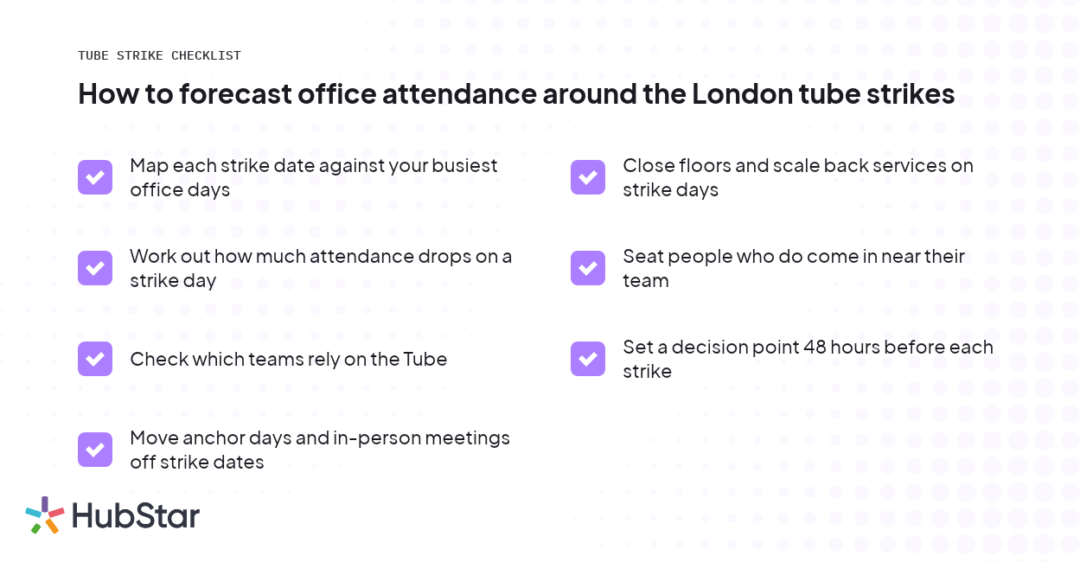
Close floors and scale back services on strike days
A half-empty building may cost almost as much to run as a full one. On strike days, bring the people who do come in onto fewer floors, and adjust catering and cleaning to match.
Floors you close can have heating and lighting turned down for the day.
This works best when you decide a few days ahead based on bookings. Once bookings for a strike date settle, you can see which floors will be close to empty and plan around them.
Give people who still come in a reason to make the trip
On strike days, your office will mostly hold people who live nearby or travel by rail, bus or the Elizabeth line. If they arrive to a quiet floor with nobody from their team, they’re less likely to bother next time.
Seat them near each other on the floors you keep open. When several people from one team can get in, make that the day for a planning session or a team lunch so the journey feels worth it.
Use strike-day data to test how much space you need
Every strike day is an opportunity to see how your office runs with fewer people in it. Compare bookings and occupancy data from strike days against a normal week, and note which floors and spaces people still choose.
The strikes also hints at where working patterns could go next.
The RMT says it’s not opposed to a genuine four-day working week but wants London Underground to withdraw its current proposals.
In Italy’s largest trade union confederation, the CGIL, had a general strike on November 20 that also called for shorter working hours. If shorter or compressed weeks spread, attendance will shift again, and strike-day data gives you an early read on how your space copes with lower numbers.
Keep plans easy to reverse while talks continue
Strikes planned for May 2026 were suspended after last-minute talks with TfL, so any of these dates could still change.
Set a decision point, such as 48 hours before each strike, and tell people when they’ll hear the final plan. On the morning itself, check TfL’s status page before sending reminders.
Jackie Towers
Share this post