AI Workplace Strategy
How Does AI Change Your Workplace Strategy?
AI changes workplace strategy in four ways. It changes how employees use the office, bringing more collaboration, more burnout and noisier open plans as people talk to their AI tools. It also turns annual occupancy planning into continuous planning, pushes everyday workplace decisions closer to the teams doing the work, and makes stakeholder alignment across CRE, HR, IT and Finance more critical.

Jackie Towers

When factories swapped steam engines for electric motors around 1900, productivity barely moved for years, until owners redesigned their factories around the new motors. That’s when the real productivity gains were realized.
The workplace is in a similar state right now. Even if Copilot, Claude, ChatGPT and Gemini make you four times as productive, that doesn’t make the entire organization more productive because the workplace operating system isn’t designed for it (yet).
That system is now outdated, because even if a few employees are using AI, it’s already changed your workplace strategy, whether you’re aware of it or not.
This post draws on HubStar’s webinar The Future of Workplace Strategy with Jane Young, which you can watch on demand right here:
Rethinking How We Plan, Decide & Act in the Age of AI
Get a full framework for updating your workplace strategy in the age of AI, from your space data to the changes you'll need to make to your human operating model.
TLDR: AI changes workplace design and speeds up individuals, but doesn’t speed up your workplace operating model. Unless you do something about it.
In Deloitte’s 2026 Global Human Capital Trends survey, 7 in 10 business leaders said their primary competitive strategy for the next three years is to be fast and nimble.
And while AI might help individuals speed up the mundane and analyze reams of data in seconds, these gains have yet to seep through to the rest of the organization.
Atlassian’s State of Teams 2026 report found 89% of executives say AI has increased the speed of work, yet only 6% can point to organization-wide ROI. The extra output accumulates at the review and approval stage of organizational workplows, creating a “fragmentation tax” Atlassian estimates costs the Fortune 500 $161 billion a year.
So now there’s a big ole’bottleneck between the doing the work and deciding what to do stages of workplace strategy.
Add on the biases AI creates, and we begin to see why a rethink of workplace strategy is necessary. In an Anthropic study published in October 2026, 50 professional analysts matched their AI agent’s secretly assigned lean 86% of the time.
Bearing all that in mind, here are four ways AI has changed workplace strategy and what to do about it.
1) AI is already changing workplace behavior. It’s going to change workplace design, too.
32% of US employees now use AI in the workplace, per Gallup. The vast majority of frequent workplace AI users (88%) say it’s changed how they use their time.
Of those users, nearly a quarter agreed they spend more time reviewing and correcting work, as well as learning new skills and tools.
Research by global design company Steelcase found that half of AI users say it’s changed how they interact with colleagues, with 78% of those users saying they now spend more time connecting than before. 37% of AI users also reported stress or burnout, with heavier use of AI correlating to higher burnout levels.
And on a more practical level, AI changed how some teams interact with their computers. Development teams, for example, might prefer speaking rather than typing their prompts using voice-to-text dictation platforms like Wispr Flow. That means open plan office spaces are getting noisier.
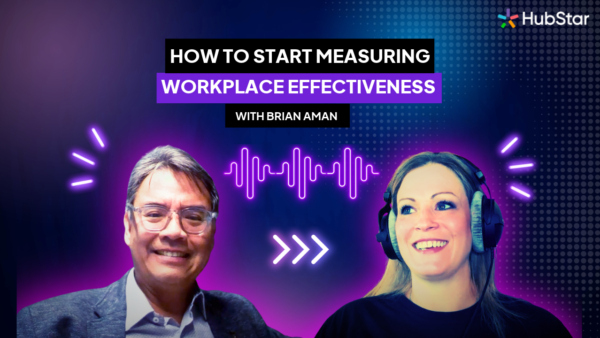
This came up in a recent episode of the Workplace Visionaries podcast with Workplace Strategy and CRE Transformation Leader Brian Aman.
“Two colleagues sitting side by side, both working with their AI agents or copilots… when they spoke into Wispr Flow, their prompts interfered with each other. So what happens to the design of space when those use cases become more prominent?”
Brian Aman
Workplace Strategy & CRE Transformation Leader @ Rogers
Check out the full episode with Brian Aman
Brian explains how talking to AI agents could reshape open plan layouts, with practical tips for making sure your workplace is effective as well as efficient.
What to do: Use workplace data, surveys and consulting with each business unit to understand how each team is using AI, and specifically how it’s changing their day-to-day. Build that data collection into you workplace strategy refresh cadences, because AI use is only going to increase from here on out.
If AI is changing how employees spend their time, how frequently they collaborate with coworkers, how burnt out they get, and how noisy the office gets, changes to your workplace strategy could include:
- Quarterly changes to the ratio of collaborative vs individual workspaces
- Adding more sound-proof office pods for specific teams
- A revamped workplace wellbeing strategy with more spaces for downtime to prevent burnout
2) Workplace planning is becoming continuous instead of annual.
AI changes occupancy planning in two ways:
- It makes demand harder to predict. JLL’s Future of Work Survey 2026 found 78% of business and CRE leaders expect AI to significantly affect their portfolio strategies within three to five years
- It removes the reason plans were annual. AI can pull live headcount, attendance and policy data into a demand model that updates itself, so the plan no longer takes months of data gathering from different teams and spreadsheet work to rebuild.
Annual occupancy planning assumes employee workplace demand stays static for an entire year. But a reorganization can change that overnight, and hybrid policies can change multiple times a year. Some HubStar customers change their floor plans as frequently as daily.
Headcount also no longer tells you how many people come in on a given day.
Continuous planning depends on trustworthy data. In JLL’s Global Occupancy Planning Benchmark Report 2026, improving space data accuracy rose to the #2 CRE priority, cited by 69% of organizations.
Nearly half rate their data capabilities as average or below, and CBRE’s 2026 Global Workplace & Occupancy Insights found 48% still use Microsoft Excel as their primary tool for analyzing utilization data.
What to do: Start with one baseline layer of workplace intelligence for your space, floorplans, people and policies, that alerts you when the mix of spaces you have doesn’t align with the ways employees are using it.
Then ask yourself, “what are the top priority decisions we need to make?”
Stop rebuilding your plan every year
If reorgs, hybrid policy changes and daily floor plan updates make your annual plan out of date by spring, this guide shows how to keep it current with live data instead.
3) Rigid, hierarchical decision making processes for workplace changes won’t work anymore.
Faster data makes little difference if every change still climbs the same hierarchy for approval.
Signing a 15-year lease and rearranging a neighbourhood carry very different risks, yet many organizations route both through similar sign-off chains.
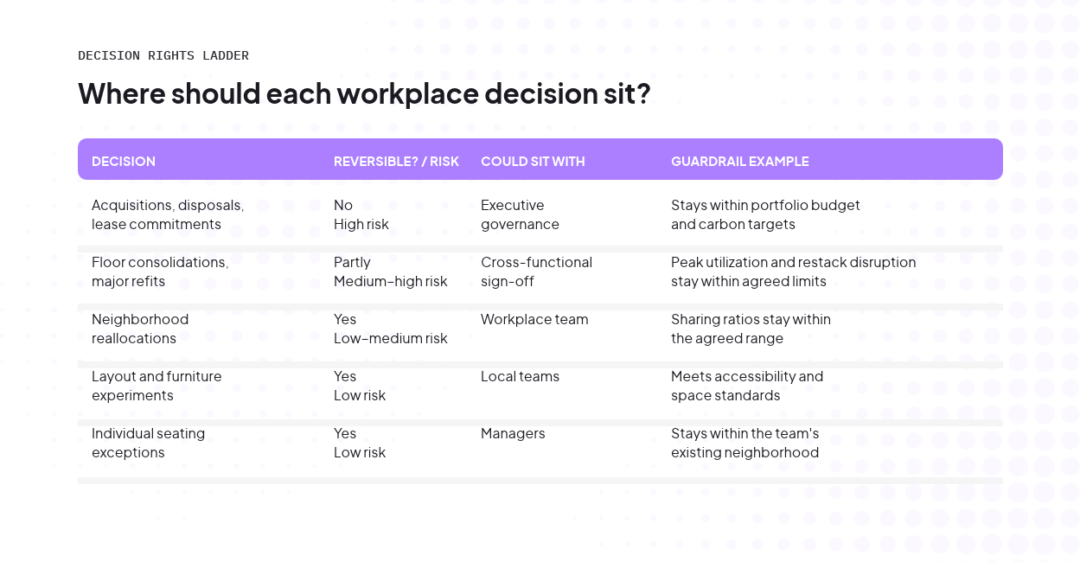
What to do: A decision rights ladder sorts decisions by risk and reversibility. Low-risk, reversible changes sit with the team closest to the work, while irreversible bets go up for approval.
Guardrails make this safe. Agree them once, then let people act within them:
- Maximum acceptable peak utilization
- Sharing ratio ranges
- Accessibility and space standards
- Disruption tolerance for restacks
- Carbon and budget limits
List your team’s decisions for this quarter and move any that don’t need executive sign-off down the ladder.
For example:
4) Even the slightest stakeholder misalignment will slow everything down.
CRE, HR, IT, FM and Finance each own part of the workplace, while outcomes like a more effective building cut across all of them. That’s why workplace leaders so often name stakeholder alignment as their biggest barrier.
In a recent poll of workplace leaders on a HubStar webinar, almost 75% agreed that stakeholder misalignment is the single biggest obstacle holding them back from positively impacting workplace change.
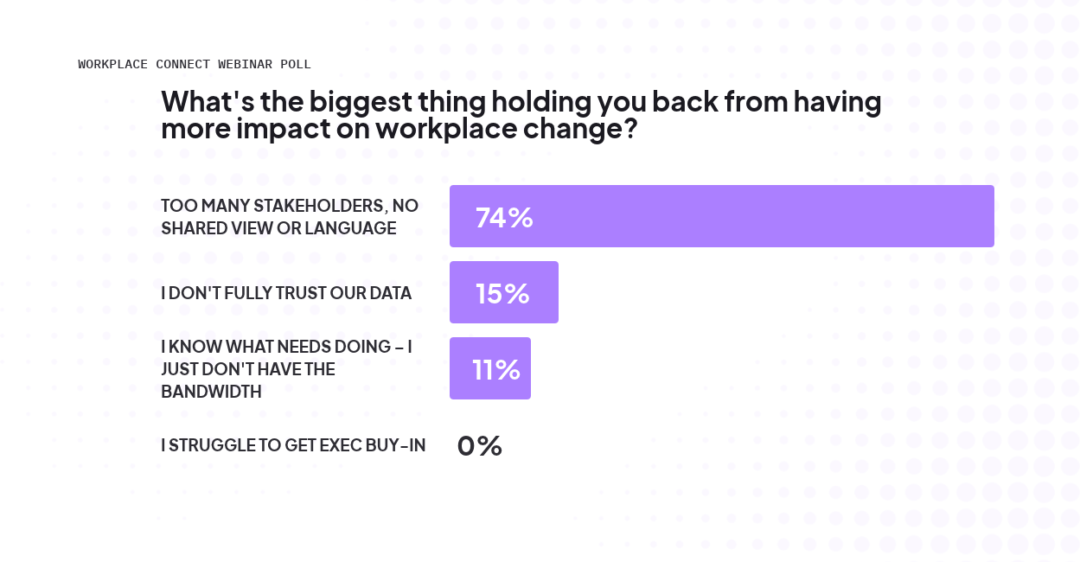
AI can help individuals within these teams analyze more data and come to more conclusions about the right workplace decisions to make.
But without established procedures for sharing that data and knowledge, individuals risk pouring time into things that aren’t organizational priorities, duplicating work, or making the wrong decisions because a coworker is sitting on data that you didn’t know existed.
For example, a monthly portfolio meeting comprised of a Workplace Strategy Lead, HR Director and CFO could mean that all three spend time building their own deck to share.
Deloitte’s 2026 research found only 28% of organizations use dynamic teams organized around the problem to be solved, while 59% say doing so will matter over the next three years.
What to do: Shared AI workflows cut coordination costs. Let’s jump back to our monthly Workplace, HR and Finance portfolio meeting. One shared workflow could produce the pack every time, with each expert owning a section.
Move status updates such as utilization, demand and lease events into always-on dashboards, and keep meetings for challenging assumptions and making decisions.
Your workplace strategy decides whether AI makes your organization faster.
Better intelligence won’t rescue a poor decision culture.
If your workplace meetings are mostly status updates and defensiveness, you risk ending up with higher-quality evidence entering a low-quality decision environment.
Watch the full webinar here
Get a full framework for updating your workplace strategy in the age of AI, from your space data to the changes you'll need to make to your human operating model.
Frequently asked questions
Will AI replace workplace strategists?
AI lets more people run sophisticated analysis themselves, but teams still need domain experts to challenge assumptions and judge the results, alongside everyday AI users, workflow innovators and technical specialists.
What is continuous work redesign?
Gartner defines it as the ability to keep redesigning workflows, decision rights, jobs and talent deployment as AI capabilities and business priorities change. Gartner also predicts that by 2028, organizations that make continuous work redesign a core capability will be twice as likely to sustain AI-driven work transformation.
Jackie Towers
Share this post