WORKTECH26: 12 Takeaways on AI, Hybrid Work and Workplace Data
In this post, HubStar's Director of Business Development Giles Ansley shares his 12 top takeaways from WORKTECH San Francisco and five actionable steps for workplace leaders.

Giles Ansley
At WORKTECH26 San Francisco, speakers from Atlassian, Meta, LinkedIn, Google, NVIDIA, Genentech, Uber, Stripe, Coinbase, Stanford and JLL looked at one question: how do you design and run a workplace that helps people do their best work?
The same three points kept coming up. AI is changing what the office is for. Hybrid attendance works better when it’s coordinated, rather than when it’s mandated. And most organizations still can’t show that their workplace changes improve team outcomes.
Here’s what we took away.
1) AI is changing what the office is for
Atlassian’s session, Designing for Decisions, Not Desks, argued that as AI speeds up individual tasks, the office matters most for the things AI can’t do. It named three behaviors to design for:
- Ideate: AI produces more ideas, but not necessarily better ones. Low-tech spaces with writable walls and flexible furniture help people think away from screens
- Calibrate: People are producing more work, so teams spend more time reviewing it and deciding. Shared displays and being close to teammates make a quick five-minute conversation easier than booking an hour-long meeting
- Regulate: Constant task switching drains attention. Quiet, tech-free spaces and biophilic design help people recover
The takeaway: desk and meeting-room counts don’t tell you whether you have the right mix of spaces for the work people actually do.
2) Human connection matters more as AI does more
Meta made the case for the “Relationship Workplace”, built on six enablers: predictable physical proximity, balanced network structure, an innovative climate, frictionless spaces, AI-enabled spaces and individual cognitive resilience.
Proximity was the key point. An employee who comes in to collaborate and finds their team at home has met the attendance policy, but the office hasn’t done its job. Organizations need to know who is coming in, not just how many, and should create spaces that encourage connections across teams too.
3) Test workplace changes instead of assuming they’ll work
LinkedIn ran an 11-week pilot comparing traditional neighborhoods with pod-based layouts. Three findings:
- Good design doesn’t guarantee adoption. Project rooms were well reviewed, but some teams used them much more than others
- Collaboration space can’t come at the expense of focus space. People need to move easily between the two
- Clear purpose drives use. Spaces with a defined function, like LinkedIn’s Co-Lab spaces, were used as intended. More vague spaces were used less
As LinkedIn put it: “When design and research work together, they turn ambiguity into clarity.” Set objectives, measure adoption, gather feedback and adjust.
How to run your own workplace pilots
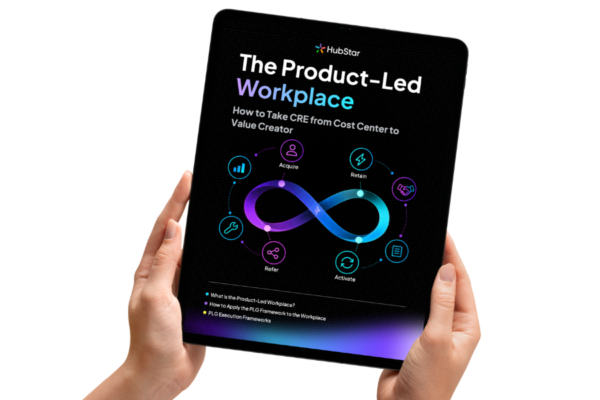
Download this guide to apply tech's most successful business model of the last decade to your workplace to run successful pilots, measure results and decide what to keep.
4) High occupancy doesn’t mean the workplace is working
At a panel with NVIDIA, Genentech, Uber and Google, attendees were asked how confident they were that their workplace changes improve team outcomes:
- 43% relied on feedback and intuition
- 31% tracked utilization and satisfaction, but not outcomes
- 13% measured outcomes and had evidence
- 13% didn’t measure outcomes at all
That’s 74% relying on intuition or indirect signals. A live poll isn’t an industry study, but it shows the gap clearly. Utilization data is the foundation. It becomes more useful when combined with employee feedback and business goals, so you can answer questions like whether rooms are the right size or how usage changed after a redesign. HubStar’s PresenceIQ is built to provide that utilization and occupancy picture.
5) Hybrid is settled, but schedule coordination isn’t
Stanford and Noro shared Flex Index data on Fortune 500 policies: 69% structured hybrid, 24% full-time in office and 7% fully flexible. Kastle Systems data shows office entries have levelled off at around 40% below February 2020.
Stanford’s Nick Bloom stressed that in-person time only pays off when people are there with the colleagues they need. Without coordination, people commute in to sit on video calls. HubStar Connect supports booking and coordination, and paired with utilization data it shows teams where demand actually falls across the week.
6) Flexibility means continually re-matching space to the business
Stripe, Google and JLL described the workplace as “never finished.” Stripe talked about planning for peak-day demand and aligning desk allocation with real attendance. Annual space reviews can’t keep up with how quickly teams grow and reorganize. HubStar Dynamic Planning helps teams model scenarios and adjust neighborhood allocations as demand changes.
7) Meeting rooms are still an easy win
Google and Stripe both flagged rooms that are booked but empty. Check-ins and automatic release free up capacity you already have. Accurate data can also show the real problem. If small rooms are always full and large ones sit empty, you may not need more meeting space, just a different mix. HubStar Connect’s booking workflows help reduce no-show reservations.
8) Make the office a magnet, not a mandate
Coinbase’s message: focus less on requiring attendance and more on making the office worth the trip, through mentoring, problem-solving and team time that’s hard to replicate remotely. The office should also feel right whether 50 or 1,000 people are in, which may mean opening or consolidating areas based on demand.
9) Cognitive wellbeing and inclusive design are now priorities
HOK, Mohawk Group, ArtLifting and Gilead Sciences covered neuroinclusive design. People respond differently to noise, light and visual stimulation, so a variety of settings beats a single default. A session on the “Brain Economy” warned about “cognitive debt” from over-reliance on AI. Several speakers noted that utilization data shows where people work, but only surveys explain why.
10) Connected data leads to better decisions
Booking, badge, HR and real estate systems usually sit in silos, which makes it hard to link people, space and demand. Speakers warned against adding tools for their own sake. The aim is simpler, connected operations. HubStar’s H2O platform combines Connect (booking), PresenceIQ (utilization) and Dynamic Planning (space planning) into one loop: understand usage, spot inefficiencies, adjust allocation and keep measuring.
11) Workplace leaders are becoming business partners
JLL and Google described workplace teams as “enterprise navigators.” Leaders are now expected to explain what the data means for the business, not just report it. For example, an underused neighborhood could be consolidated or given to a growing team. Building a business case means looking at utilization, experience, cost and outcomes together.
12) The biggest gap is understanding how work is changing
When asked about the biggest gap between AI adoption and workplace strategy, attendees answered:
- 33% understanding how work is changing
- 17% connecting technology and data
- 17% measuring the effect on performance
- 15% adapting space and settings
- 9% building skills and confidence
- 8% supporting team coordination and decisions
AI moves in months while real estate decisions take years. Before you can plan space for new ways of working, you need to understand them, and that means continuous measurement and experimentation.
Five priorities for workplace leaders
- Design for activities, not just occupancy. Provide settings for the different kinds of work people do.
- Make in-person time intentional. Help people coordinate with the colleagues they need.
- Connect data to decisions. Use utilization data to find inefficiencies and guide planning.
- Plan continuously. Revisit space requirements as the business changes.
- Measure more than attendance. Combine occupancy data with feedback and performance indicators.
See how HubStar can help
Unify workplace booking, occupancy intelligence and dynamic space planning, so you can see how your workplace is used and adapt it as your business changes.

Giles Ansley
Share this post