What Both Sides Are Getting Wrong in the Barclays RTO Row
Last month, the UK's Barclays Bank mandated employees into the office three days instead of two, resulting in 36,000 employees writing an open letter demanding the mandate be reversed. In this post, HubStar's Paul Mundy reflects on what both sides of the debate are missing, and what organizations can do to avoid damaging post-mandate backlashes.

Paul Mundy

Thousands of Barclays staff signed an open letter last month pushing back on a move from two office days a week to three. Their asks were:
- exemptions for anyone with a commute over 40 minutes
- flexibility for carers
- a one-off payment to cover travel and childcare costs
Barclays says the extra day builds collaboration, mentoring and culture. The union says the bank hasn’t shown the evidence to back that up.
I wrote three LinkedIn posts reacting to this story over the past few weeks. The first was read by more than 230,000 people, and the comments went places I didn’t expect. My view hasn’t changed: both sides are arguing from belief and not from what the data actually says.
That’s worth sitting with, because the same arguments are playing out within many large organizations right now. And I think almost everyone involved, on both sides, is debating the wrong thing. Here’s why.
Everyone’s arguing over the number of days.
The public fight is about two days versus three. That’s the headline, the quote in the paper and the line in the open letter, but the least useful thing to argue about.
61% of financial services employers want staff in three or more days a week. Only 32% are getting it, according to CBRE. That gap exists across an industry that has, by most accounts, tried hard to mandate its way to a number.
The reason behind some of that gap is the commute, but a lot of it is something simpler: people come in, find the office either half-empty or rammed, and decide it wasn’t worth the trip. Add a mandated day on top of that experience, and all you’ve added is friction and a negative workplace experience.
"An empty Monday tells people there's no point coming in. A packed Tuesday tells people there's no room. Neither problem gets fixed by adding a third mandated day."
Paul Mundy
Senior Business Development Manager @HubStar
The number of days is a policy decision. Whether people are glad they made the trip depends on what they find when they get there.
The real question is: which days, and is there room for everyone on them?
Before changing a policy that affects thousands of people, I’d want answers to four questions:
- Which days are already busy, and which are sitting empty?
- Do the teams who say they need to collaborate in person actually sit together when they come in?
- Are the meeting rooms full, or just booked and unused?
- If every team picks the same day, is there physically room for them?
An empty Monday tells people there’s no point coming in. A packed Tuesday tells people there’s no room. Neither problem gets fixed by adding a third mandated day. Both get fixed by knowing when teams actually overlap, giving them a reason to come in together, and making sure the space can hold them when they do.
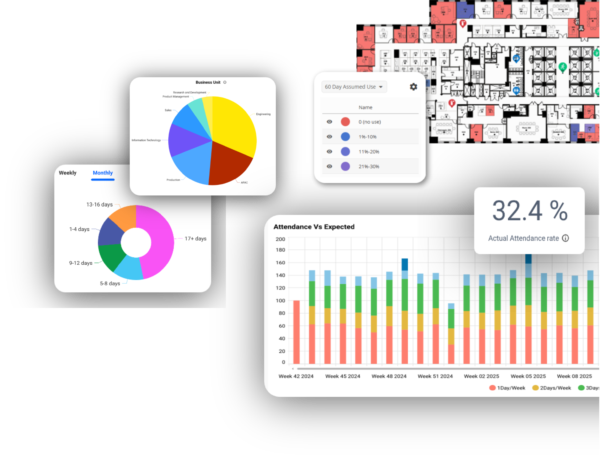
Occupancy data shows which desks, rooms and floors are used, by whom, on which days. Most organizations setting attendance policies right now don’t have occupancy data in front of them when they make the call.
One rule doesn’t fit multiple cities
Barclays operates across markets with very different offices, commutes and space constraints. A single global rule (three days, every site, every team) assumes those sites are interchangeable. They aren’t.
A floor that’s half-used in Glasgow and a floor that’s overflowing in London each need their own fix, worked out on their own terms.
There’s a second ambiguity sitting underneath all of this: nobody involved has defined what success looks like. Is it attendance, productivity or retention increases, or is it a mix of all three? Each of these points to a different measure, and a mandate that “improves” one can damage another.
If the policy isn’t working in 12 months, somebody needs to have already agreed what success was supposed to look like, and who’s accountable for checking.
5 Reasons Why Hybrid Work Policies Fail
Take any of the very public hybrid work failures from the last few years and they'll feature at least one of these 5 reasons for failure, from a lack of manager autonomy to no shared definition of success.

What the mandates that actually work have in common:
I’ve seen plenty of attendance mandates land badly, and a smaller number that stuck. The ones that stuck shared three traits.
- Team-level expectations. This lets a trading floor and a design team land on different in-office days, because they collaborate differently. The advantage is that each team’s schedule matches how it actually works. The benefit: higher attendance on the days that matter to that team, and less resentment on the days that don’t.
- Measuring space usage before and after the change, then adjusting. This gives leaders a before-and-after picture of which floors, desks and rooms are actually used once the new policy lands. The advantage is that the mandate becomes something leaders check and correct on a set schedule. The benefit: a policy that keeps improving and keeps people’s trust.
- Explaining the “why” with evidence. This gives employees the same data leadership used to create the mandate. The advantage is that people can see the reasoning and argue with the data if they disagree. The benefit: a mandate people can genuinely live with.
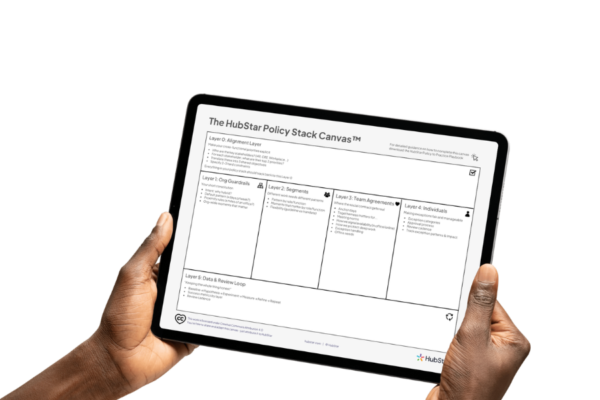
Effective hybrid policy creation template
Download this hybrid policy creation template to map out priorities and key questions to answer from organizational down to the individual level and start getting aligned on the data you'll need.
What to look for before you set or defend an attendance policy:
Whatever your organization decides on days, here’s what I’d want in place first.
- The ability to see actual space usage by day, team and location. This shows you where the office is genuinely busy or empty. You get to make the “which days” call on evidence.
- A way to compare planned attendance against what actually happens. This surfaces the gap between the policy on paper and the behavior in the building. You find out fast whether a new mandate is working.
- A route from raw occupancy numbers to a decision someone can defend. This turns badge, Wi-Fi, sensor and booking data into something a real-estate or workplace lead can put in front of a union, a CFO or an open letter and stand behind. You get a policy you can explain and defend.
This is the gap HubStar works in: pulling together space and occupancy data so leaders can see how the office is actually used, day by day, team by team.
Our partner Audiem gathers the qualitative side, what people actually think and feel about coming in. Combined, the two give you a fuller picture than either gives you alone.
Create evidence-based hybrid work policies with HubStar
HubStar shows you how employees use your existing office spaces, so you can create and implement hybrid work policies without the risk of a Barclays-style backlash.
Paul Mundy
Share this post