3 Steps to Saving Millions in Campus Space Management

Jackie Towers

The typical large North American research university sits on a real estate portfolio worth $5 billion. Most have no real picture of how it’s actually being used.
That’s the central finding in JLL’s Higher Education Portfolio Benchmark, the first research of its kind to measure campus space management practices across 12 leading North American universities, representing 173 million square feet of facilities and 285,000 students.
On June 9th, three of its authors joined HubStar’s Joe Harris and Co|Here’s Chris Morett for the latest session of the Future of Campus Spaces webinar series: Krista Trofka, Head of Higher Education Advisory at JLL; Dmitri Gerchikov, Global Lead for Space, Data and Insight; and Lu Gravelle, Senior Director for Occupancy Planning.
Three ways to start uncovering and acting on these areas for cost savings stood out.
Watch the full recording here
Private faculty offices, revenue strategies for underutilized assets, and how to run a pilot that gets leadership off the fence. All of that is in the full recording - check it out here.

Step 1) Get visibility into your space utilization data.
81% of the institutions surveyed have no formal space management KPIs in place. Only 50% track space utilization, compared to 74% across other industries. The most frequent method for tracking occupancy is the annual manual count or walk-through surveys. The problem here is that it’s just a single snapshot that tells you almost nothing about how space actually behaves across a term, or a year.
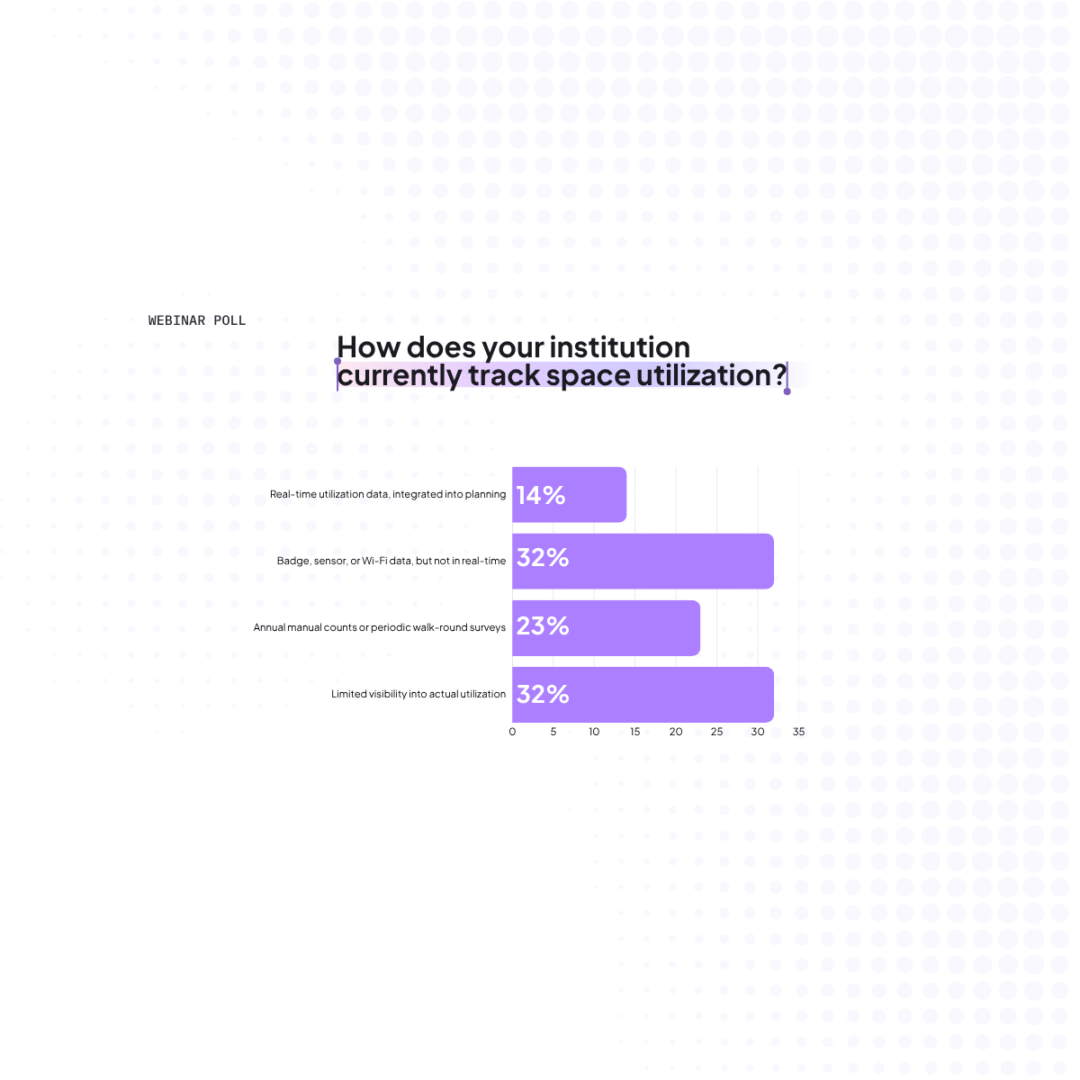
A live poll of webinar attendees reflected this exactly. Just 14% had real-time or near-real-time utilization data integrated into planning.
Higher education actually leads the corporate sector on using Wi-Fi signals to track utilization, partly because it maps well to lecture hall-scale spaces. But Wi-Fi alone only tells you where people congregate. Building-level heat maps can’t tell you which seats were used, which collaboration rooms were at capacity, or which bookable spaces were never touched. More granular measurement that combines reservation data, sensors, and Wi-Fi analytics calibrated to individual rooms and workstations is what’s actually required to make cost-effective decisions.
One university in North Carolina, cited in the research, illustrates the gap clearly. They knew their classroom utilization was around 54%. What they lacked was any benchmark to know whether that number was acceptable. Without a KPI to measure against, data isn’t actionable.
Getting to that visibility is the diving board for better decision making.
Step 2) Pinpoint areas with ghost capacity hiding in plain sight across campus.
This is where JLL’s research gets specific, and where space managers have their strongest argument for leadership investment in better campus space management processes.
The universities in the study had a target classroom allocation of 75%. But in practice, only 42% of classrooms were actually assigned to a class. That’s a 33-point gap between stated intent and operational reality, before you even factor in actual attendance. After assignment, the utilization story compounds it further: a target of 73% against an actual of 63%.
“Ghost capacity” was the phrase Lu Gravelle used on the call. These are spaces that appear productive on paper, carry full HVAC and maintenance costs but are sitting empty more frequently than not.
JLL modelled what a 10-15% efficiency gain across classrooms and office/admin space would mean for a typical large university. The result is $2 to $4 million per year in operational expenditure savings, from simply not operating space that nobody is using.
"If you look at the actual utilization, it could be that we actually have 60% capacity that we could still use. That could save tens of millions of dollars in construction and planning."
Lu Gravelle
Senior Director of Occupancy Planning at JLL
The case study that makes this concrete comes from a major North American research university JLL has worked with for over eight years. It deployed a Wi-Fi utilization tracking system across more than 20 million square feet of campus, layered space personas onto the usage data, and built out proper KPIs. The outcomes were:
- $14 million in savings from strategic building divestment
- $760,000 in cost avoidance through lab space recovery and restacking
- An 8x increase in student study spaces
- Tuition held flat for 14 consecutive years
This is what it looks like when a campus operates from data rather than assumption. Aggregating Wi-Fi, sensors, booking data, and facility condition assessments into a single view is what makes decisions at this scale possible. HubStar’s PresenceIQ does exactly this, giving campus and estates teams the evidence they need to act with confidence.
Step 3) Move the needle with authority and culture.
Joe asked the obvious question: given all of this, why haven’t institutions moved faster?
JLL’s answer was that three blockers prevent this: data, authority, and culture.
The data problem is familiar. Without visibility into how space is being used, there’s no case for change, and the portfolio stays as it is. Krista Trofka put it in the words of one participant:
"The space planning team spends so much time chasing people, we can't focus on more important tasks, like analyzing productivity."
Participant
in JLL's Higher Education Portfolio Benchmark Study
The authority problem is less talked about but equally real. Several space managers in the research described being responsible for the portfolio without any seat at the decision-making table. One told JLL directly: “I’m responsible for space across campus, and I’m not a part of the decision-making process.“ Without authority, even good data becomes an internal report that goes nowhere.
Then there’s culture, and this is the most stubborn layer. Space in higher education is typically allocated by seniority and custom rather than by need, although this is changing. Departments like to hold onto their rooms, and faculty offices are treated as untouchable. Almost no universities have chargeback policies that make departments genuinely accountable for the space they occupy.
Chris Morett framed the accountability gap in the most direct terms of the session:
"I don't know anybody of any institution who gets rewarded or punished based on utilization. The metric is: avoid disaster."
Chris Morett
Co|Here Campus & Workplace
Until boards and senior leadership create explicit incentives around space performance, the status quo will persist regardless of how good the data gets.
There is a practical path forward, though, and Dmitri Gerchikov described it well: start simple. Find the right accuracy of data at the right price point to support one specific decision. Show leadership a concrete output. Then use that win to secure funding for the next iteration. Building the business case is a muscle, and it strengthens with each iteration.
"The more we can help this space manager start to unlock building the business case for the campus, the more effective we're all going to be."
Krista Trofka
Head of Higher Education Advisory, JLL
Authority and cultural change tend to follow from data. What you can measure, you can prove. What you can prove, you can build a business case for that leadership can’t ignore.
Watch the full recording here
Get all the details on how one university JLL worked with cracked the code on faculties holding onto their private spaces, why Chris advises picking something that "horrifies your leadership team" to get a pilot going, and much more.
Jackie Towers
Share this post