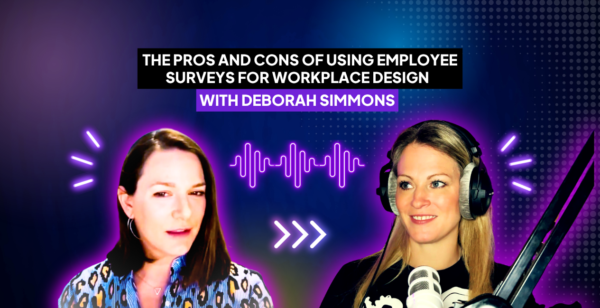
Mandates Won't Fix Your Empty Office with Brian Huber

Jane Young Host

Brian Huber Guest
"Forcing them into the office five days a week, in a space they don't want to be in...do you really think you're going to get a more productive workforce that way?"
Brian Huber
Workplace Strategy Lead @ Pinterest
Forcing people back into an office five days a week doesn’t make them more productive. It just fills a space they didn’t want to be in.
Brian Huber has spent his career watching that math play out, and he says most companies are still solving the wrong problem.
On this episode of Workplace Visionaries, host Jane Young sits down with Brian Huber, who spent close to 12 years running corporate real estate and occupancy planning at Salesforce through its hypergrowth years (the San Francisco HQ went from 8 floors to roughly 75, about 1 million square feet, in just 3-4 years), then moved to Pinterest, where he’s led workplace and occupancy strategy for almost five years.
Brian walks through the demand-modeling method his team built at Pinterest: instead of planning space around how many people are on the payroll, they size it around the 80th percentile of attendance on the three busiest days of the week, whatever those days happen to be. That single shift is why a change in attendance rate (say, from 25% to 50%) moves office demand far more than adding headcount ever does.
The conversation covers what that looked like in practice: dropping assigned 1:1 desks for neighborhoods, cutting workstation allocation from roughly 50-60% of the floor down to 10-15%, and growing collaboration space from about 15-20% up to 30-40%. Square footage per person went up (from around 200 to 350 sq ft), and the total portfolio still shrank, because fewer people are being planned for at any given moment.
We also get into why flexible work didn’t start with COVID (hot-desking and open-plan layouts were already spreading a decade earlier), why commute keeps coming out as the number one reason people skip the office, why meeting-room booking data is close to useless for planning, and why getting real estate, HR, and executive leadership speaking the same language about “demand” and “attendance” is one of the hardest parts of the job.
In this episode:
- Why deep tenure (not job-hopping) built the institutional knowledge behind these changes
- Planning three years ahead during Salesforce’s hypergrowth Why pre-COVID office attendance never hit 100%, even at its best
- The 80th-percentile method for sizing space to real demand, not average or peak-day extremes
- Pinterest’s shift from assigned desks to neighborhoods, and the space math behind it
- Why badge data plus sensor data beats meeting-room bookings for understanding real usage
- Where AI tools help with occupancy analysis today, and where they still fall short
- Getting leadership aligned on a shared definition of “demand” before you redesign anything
- Why the goal isn’t just cutting cost: offices people actually want to use drive retention too
Brian Huber is a workplace and occupancy planning leader with a background in anthropology from UCLA, whose career spans corporate real estate at Salesforce and, currently, Pinterest.
Workplace Visionaries
Never miss an episode

HubStar
Follow HubStar across the web
HubStar
Share this post